KEY TAKEAWAYS
- Wired vs wireless deck lighting comes down to upfront cost versus long-term reliability and brightness.
- Low-voltage wired systems run on 12 volts and suit permanent, whole-deck lighting plans.
- Solar deck lights depend on direct sun, so shaded decks and under deck lighting struggle.
- Battery-powered lights install in minutes but need regular recharging or battery swaps.
- Plan transformer size and wire gauge before buying fixtures to avoid dim lights later.
- Choose waterproof deck lights with a wet-location rating for any exposed fixture.

Choosing between wired vs wireless deck lighting is one of the first decisions you’ll make when lighting an outdoor space, and it shapes everything that follows. It affects how bright your deck looks, how much you spend over time, and how often you’ll be on your knees replacing fixtures.
Wired systems promise steady, even light from a single power source. Wireless options promise a weekend install with no trenching or electrical work. Both claims are true, but only in the right setting.
This guide breaks down how each system works, what you’ll actually pay for, which deck lighting fixtures pair best with each option, and how to plan an install that holds up season after season.
How Wired and Wireless Deck Lights Work
Wired Low-Voltage Systems
Most wired outdoor deck lighting today is low voltage. A transformer plugs into a standard outdoor outlet and steps household 120-volt power down to a safer 12 volts. Low-voltage cable then runs to each fixture along joists, posts, and stair stringers.
Because every light draws from the same source, brightness stays consistent across the deck. Most systems also connect to a timer, photocell, or smart controller, so lights turn on at dusk without anyone touching a switch.
Wireless Solar and Battery Systems
Wireless deck lights come in two main types. Solar lights have a small panel that charges an internal battery during the day and powers an LED at night. Battery-powered lights use rechargeable or disposable batteries and often include a remote or motion sensor.
Each fixture works on its own. That independence makes installation simple, but it also means brightness and runtime vary from light to light depending on sun exposure and battery health.
One quick note: some products marketed as “wireless” actually use wired fixtures with wireless app controls. In this article, wireless means fixtures with no power cable at all.
Wired vs Wireless Deck Lighting: Side-by-Side Comparison
| Factor | Wired (Low-Voltage) | Wireless (Solar / Battery) |
|---|---|---|
| Upfront cost | Higher (transformer, cable, fixtures, labor) | Lower (fixtures only) |
| Installation | Planning, cable routing, often a pro | DIY in an afternoon |
| Brightness | Strong and consistent | Softer, varies by charge |
| Reliability | Works every night, any weather | Drops on cloudy days or in shade |
| Lifespan | Long-lasting fixtures and transformer | Batteries and panels wear out sooner |
| Maintenance | Occasional connection checks | Cleaning panels, replacing batteries |
| Controls | Timers, photocells, smart apps | Built-in sensors, limited control |
| Best for | Permanent, whole-deck designs | Renters, quick upgrades, sunny spots |
Pros and Cons of Each System
Wired Deck Lighting
Pros:
- Bright, uniform light across railings, steps, and posts
- Runs on a schedule with no daily attention
- Fixtures are typically sturdier and better sealed
- Adds lasting value to a finished outdoor living space
Cons:
- Higher upfront cost for materials and installation
- Requires planning around transformer capacity and wire runs
- Harder to add after decking boards are installed
- Needs a GFCI-protected outdoor outlet nearby
Wireless Deck Lighting
Pros:
- Low cost per fixture and no wiring
- Easy to move, add, or remove at any time
- No impact on your electric bill
- Good option for renters or temporary setups
Cons:
- Dimmer output that fades through the night
- Poor performance on shaded decks and in winter
- Batteries and solar panels degrade over time
- Mixed brightness when fixtures age at different rates
Cost Comparison: 5 Factors That Decide What You Pay
Prices vary widely by region, brand, and deck size, so it helps to look at what drives cost rather than a single number.
- Fixtures. Wired fixtures usually cost more each because they’re built with heavier housings and better seals. Wireless fixtures are cheaper and often sold in multi-packs or deck lighting kits.
- Power source. Wired systems need a transformer sized for the total wattage of every fixture. Wireless systems skip this cost entirely.
- Installation labor. A wired system may need a professional installer, especially on an existing deck. Wireless lights are almost always DIY.
- Operating cost. Low-voltage LED systems use very little electricity. The U.S. Department of Energy notes that LEDs use far less energy and last much longer than incandescent bulbs. Wireless lights cost nothing to run.
- Replacement cost. This is where wireless often catches up. Many homeowners report replacing solar lights or their batteries every few seasons, while quality wired fixtures can run for many years.
Over a long ownership period, the cost gap between wired and wireless often narrows more than people expect. If you plan to stay in your home for years, wired usually delivers better value per year of use.
Matching Deck Lighting Fixtures to the Right System
Not every fixture type works equally well with both power options.
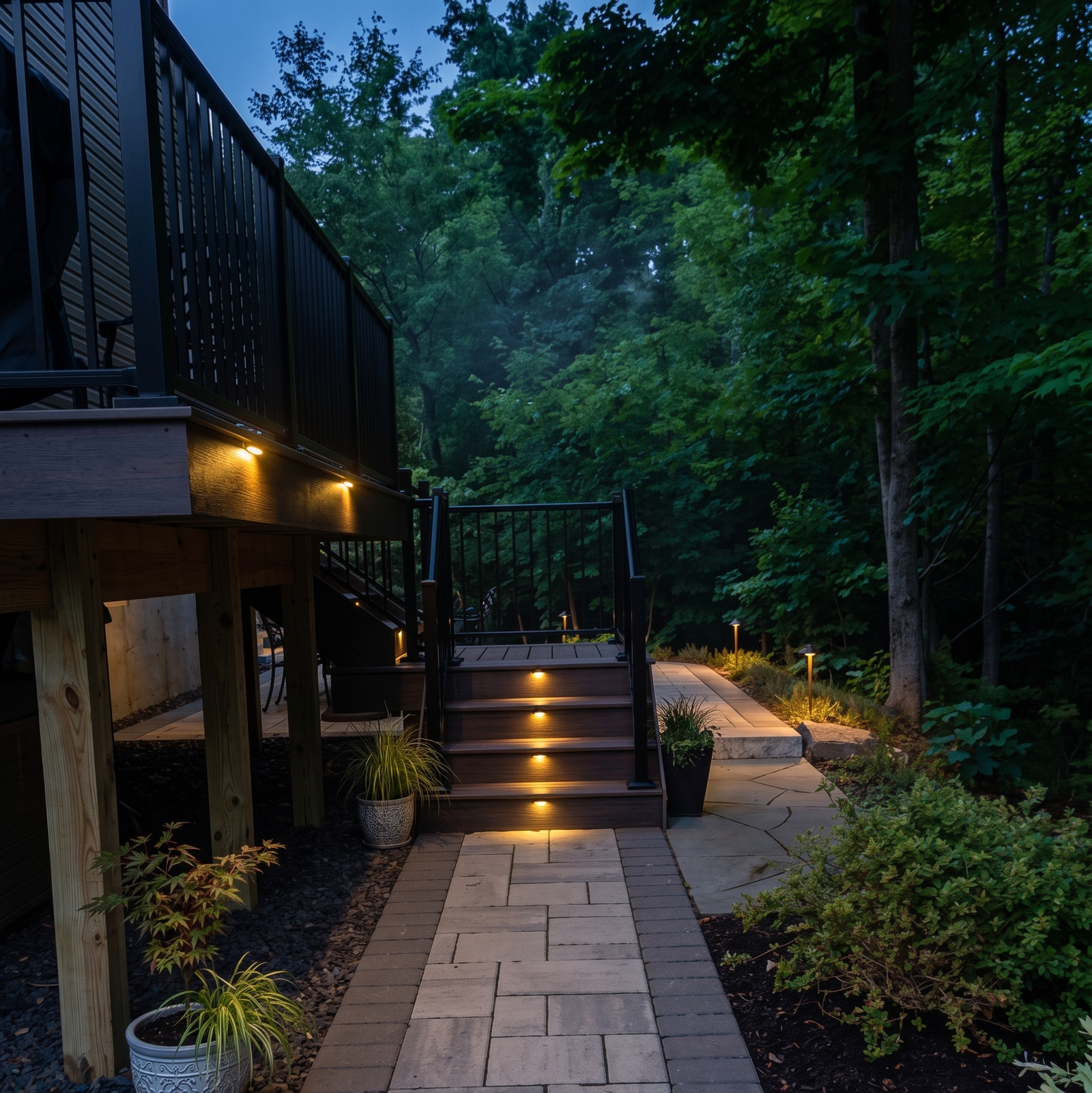
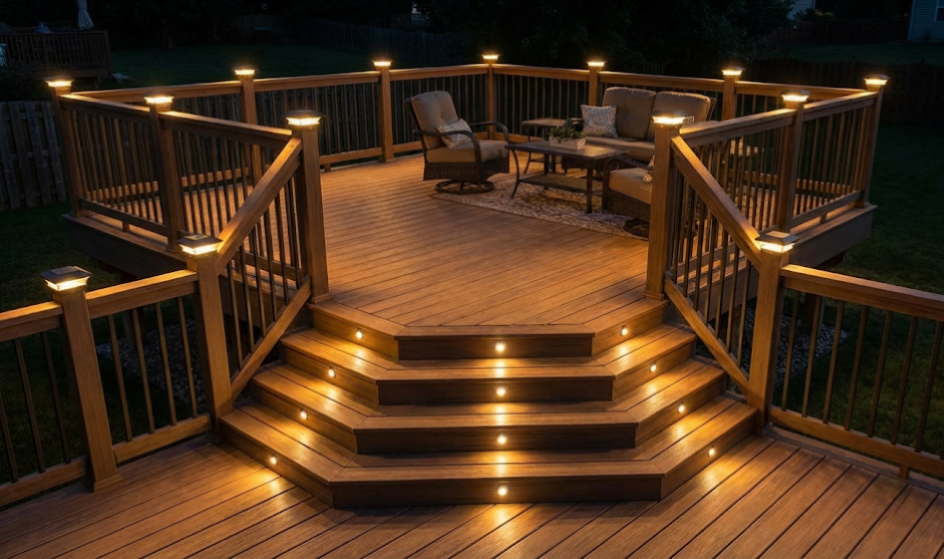
- Deck step lighting: Safety lighting on stairs should be reliable every single night. Wired is the stronger choice here.
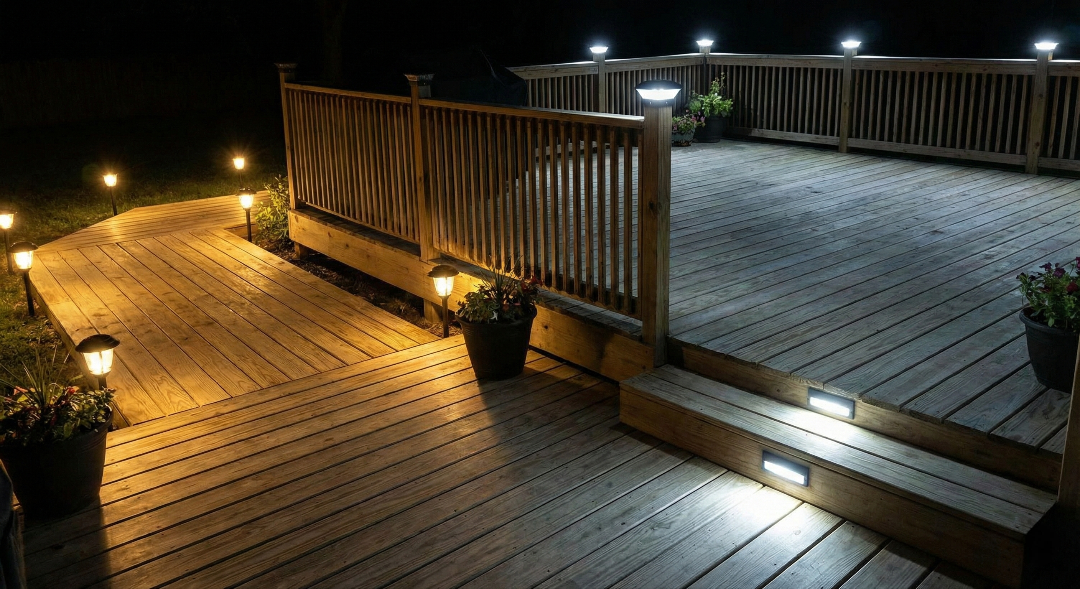
- Deck railing lights: Both work. Wired gives even light along long runs, while solar railing lights suit short, sunny sections.
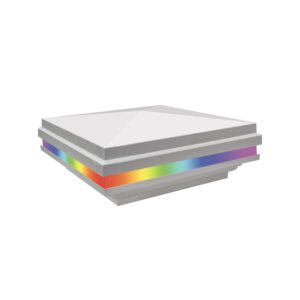
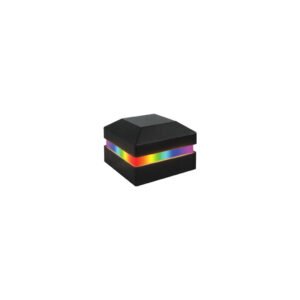
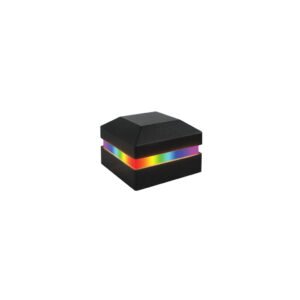
- Deck post cap lights: Solar post caps are popular because the top of a post gets direct sun. Wired post caps give steadier light and a cleaner look.
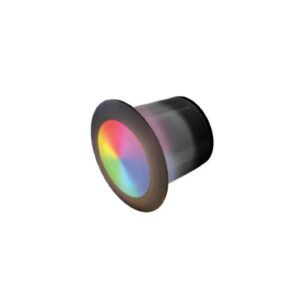
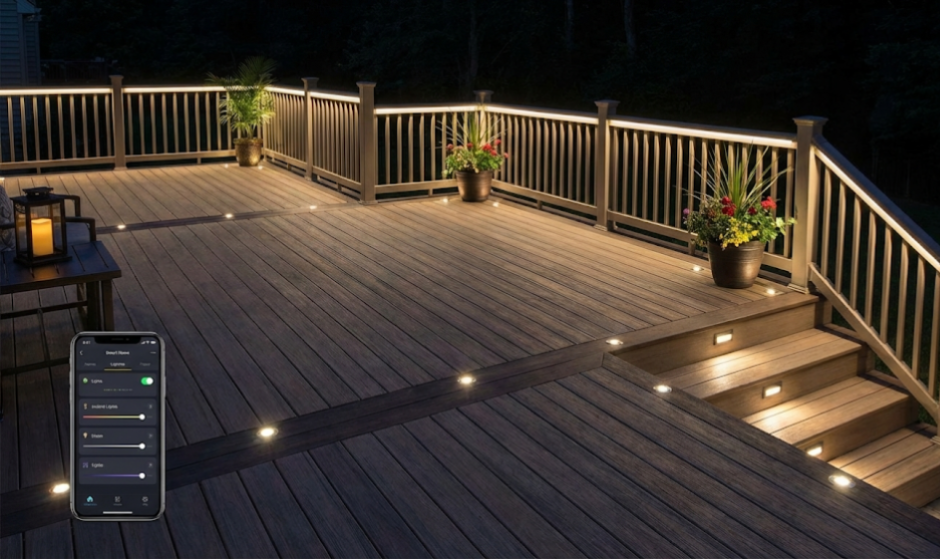
- Recessed deck lighting: Fixtures set flush into boards or risers are almost always wired. They need cable routed underneath.
- Under deck lighting: Areas below a raised deck rarely get sun, so solar is a poor fit. Use wired fixtures or rechargeable battery puck lights.
Whatever you choose, pick waterproof deck lights. UL offers wet-location listings for outdoor fixtures, and IP ratings under the IEC standard tell you how well a fixture resists water. IP65 handles rain and spray, while IP67 can handle short-term submersion.
How to Decide: Which System Fits Your Deck?
A few simple scenarios make the choice clearer.
- If you’re building a new deck or replacing the boards, choose wired. This is the easiest time to run cable and install recessed fixtures, and adding them later costs more.
- If your deck is shaded by trees, a house wall, or an upper level, choose wired or battery lights. Solar panels need several hours of direct sun to charge well.
- If you rent your home or plan to move within a year or two, choose wireless. You can take the lights with you.
- If stair safety is your main goal, choose wired step lights. Dim or dead fixtures on stairs create a tripping hazard.
- If you want accent lighting fast on a small budget, start with solar post caps and upgrade later.
How to Plan a Wired Low-Voltage Deck Lighting Install
- Map your fixtures. Sketch the deck and mark every step, post, and railing light you want.
- Add up total wattage. Total the wattage of all fixtures. Many installers recommend a transformer rated well above that total, often loading it to about 80% of capacity, to leave room for future additions.
- Choose wire gauge. Longer runs lose voltage, which makes the farthest lights dimmer. Heavier cable, such as 12 or 10 gauge, reduces this on long runs.
- Confirm your outlet. The transformer should plug into a GFCI-protected outdoor receptacle with a weatherproof in-use cover, as the National Electrical Code (NFPA 70) requires for wet locations.
- Route and secure cable. Run cable along joists and stringers, keep it off the ground where possible, and use clips rated for outdoor use.
- Connect and test. Connect fixtures with waterproof connectors, power the system, and check every light before closing anything up.
- Set controls. Program the timer or photocell so lights turn on at dusk and off at a set hour.
Local codes vary, so check with your building department or a licensed electrician before installing, especially if you need a new outdoor outlet.
Do’s and Don’ts of Deck Lighting
Do:
- Use fixtures with a wet-location rating
- Choose warm color temperatures (2700K to 3000K) for a relaxed glow
- Light every stair tread, not just the top and bottom
- Aim fixtures down to reduce glare, as DarkSky International recommends
Don’t:
- Overload a transformer to its full rated capacity
- Place solar lights in spots that get less than a few hours of sun
- Mix fixtures with very different color temperatures
- Leave cable connections exposed to standing water
Real-World Scenario
A homeowner in Pennsylvania has a two-level composite deck with a covered lower section and an open upper section. They first install a solar kit across both levels.
The upper deck looks good through summer. The lower level stays dim most nights because it never gets direct sun, and by late fall, many of the upper lights shut off within a few hours.
They switch to a hybrid plan: wired step and recessed riser lights on both staircases, wired under deck lighting on the covered level, and solar post caps on the sunny upper railing. The result is reliable safety lighting where it matters and low-cost accent lighting where the sun can do the work.
Quick Answers:
Is wired or wireless deck lighting better?
A: Wired deck lighting is better for brightness, reliability, and lifespan. Wireless is better for low cost, quick installs, and renters.
Do solar deck lights work in winter?
A: They work, but shorter days and a lower sun angle mean less charging. Expect dimmer light and shorter runtimes.
Can I install low-voltage deck lights myself?
A: Many homeowners do, since the low-voltage side runs at 12 volts. You still need a properly protected outdoor outlet, and local codes may have extra rules.
How long do solar deck lights last?
A: It depends on panel and battery quality. Batteries usually wear out first and can often be replaced.
What are the best lights for deck stairs?
A: Wired step or riser lights are best because they stay consistently bright every night.
Can I mix wired and wireless deck lights?
A: Yes. Many homeowners use wired lights for stairs and main areas and solar post caps or railing lights for accents.
Are deck lighting kits worth it?
A: Kits are a good value for small decks because they include matched fixtures, cable, and often a transformer. Check that the transformer has room to grow.
What color temperature should deck lights be?
A: Most homeowners prefer warm white between 2700K and 3000K for a soft, inviting look.
Glossary of Terms
- Low-voltage lighting: A lighting system that uses a transformer to reduce household 120-volt power to about 12 volts, making it safer for outdoor use.
- Transformer: The device that converts standard household power to low voltage and often includes a built-in timer or photocell.
- Voltage drop: The loss of power along a long cable run, which can make fixtures farther from the transformer look dimmer.
- IP rating: An international code that shows how well a fixture resists dust and water. Higher numbers mean better protection.

Conclusion
The wired vs wireless deck lighting decision comes down to how long you plan to enjoy your deck and how much you want the lights to just work. Wired low-voltage systems cost more upfront but give you bright, even light every night with very little upkeep. Wireless solar and battery lights cost less and install fast, but they trade away brightness and long-term reliability.
For most homeowners planning to stay put, wired lighting on stairs and main areas, with solar accents where the sun hits, offers the best balance.
Ready to light your deck the right way? Talk to a deck lighting specialist about a layout built around how you actually use your outdoor space.