- FREE Shipping on all orders! Limited time!
- support@tru-scapes.com

Upgrading your outdoor space doesn’t have to mean hiring an electrician or tearing up your deck boards to run conduit. Wireless deck lighting has matured significantly in recent years, and today’s options range from elegant solar post cap lights to powerful battery-operated recessed fixtures that rival hardwired performance.
This guide covers every major wireless deck lighting category — from deck step lighting to under deck lighting — so you can make a confident, informed decision before spending a single dollar. You’ll get honest pros and cons, a direct comparison table, installation tips, and answers to the questions homeowners ask most.
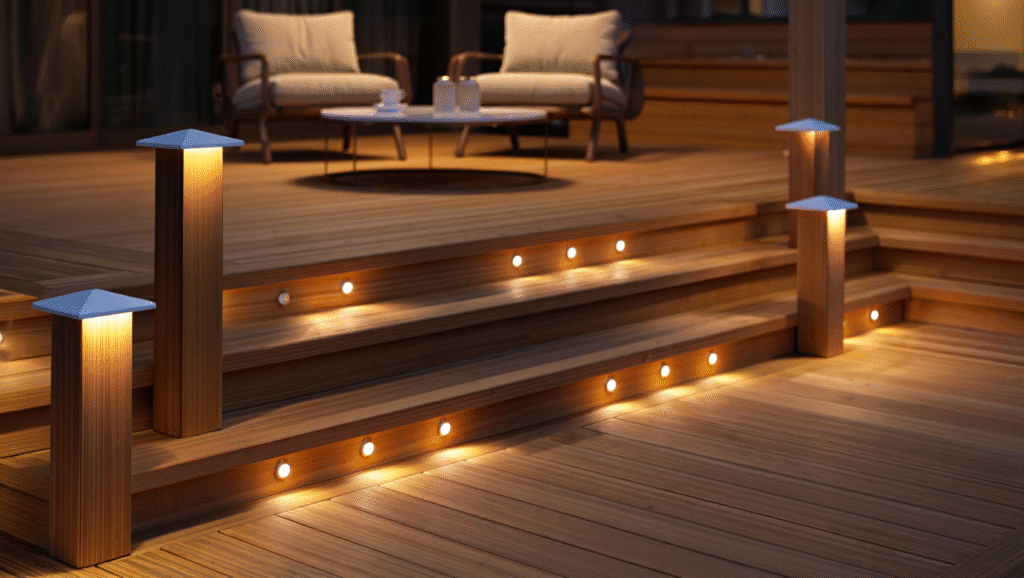
“Wireless” in outdoor lighting typically refers to one of two power sources: solar energy or replaceable/rechargeable batteries. A third emerging option — low-voltage RF-controlled systems — also qualifies, though these still require a power source at the controller. For those weighing the differences between these power sources, our guide on solar vs. electric deck lights provides a detailed breakdown to help you choose.
Solar deck lights use a small photovoltaic panel to charge an internal battery during the day and discharge it at night. According to LED lighting basics from the U.S. Department of Energy, modern photovoltaic cells and LEDs have become significantly more efficient, allowing even compact solar fixtures to provide reliable illumination. Battery-powered deck lights run on standard or rechargeable cells and can be placed anywhere regardless of sun exposure.
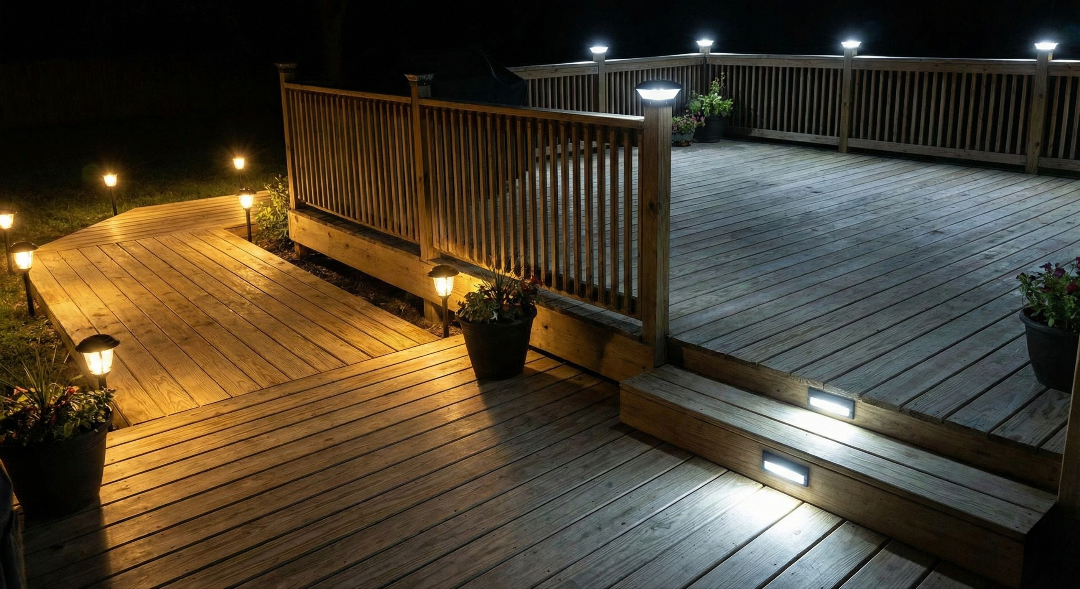
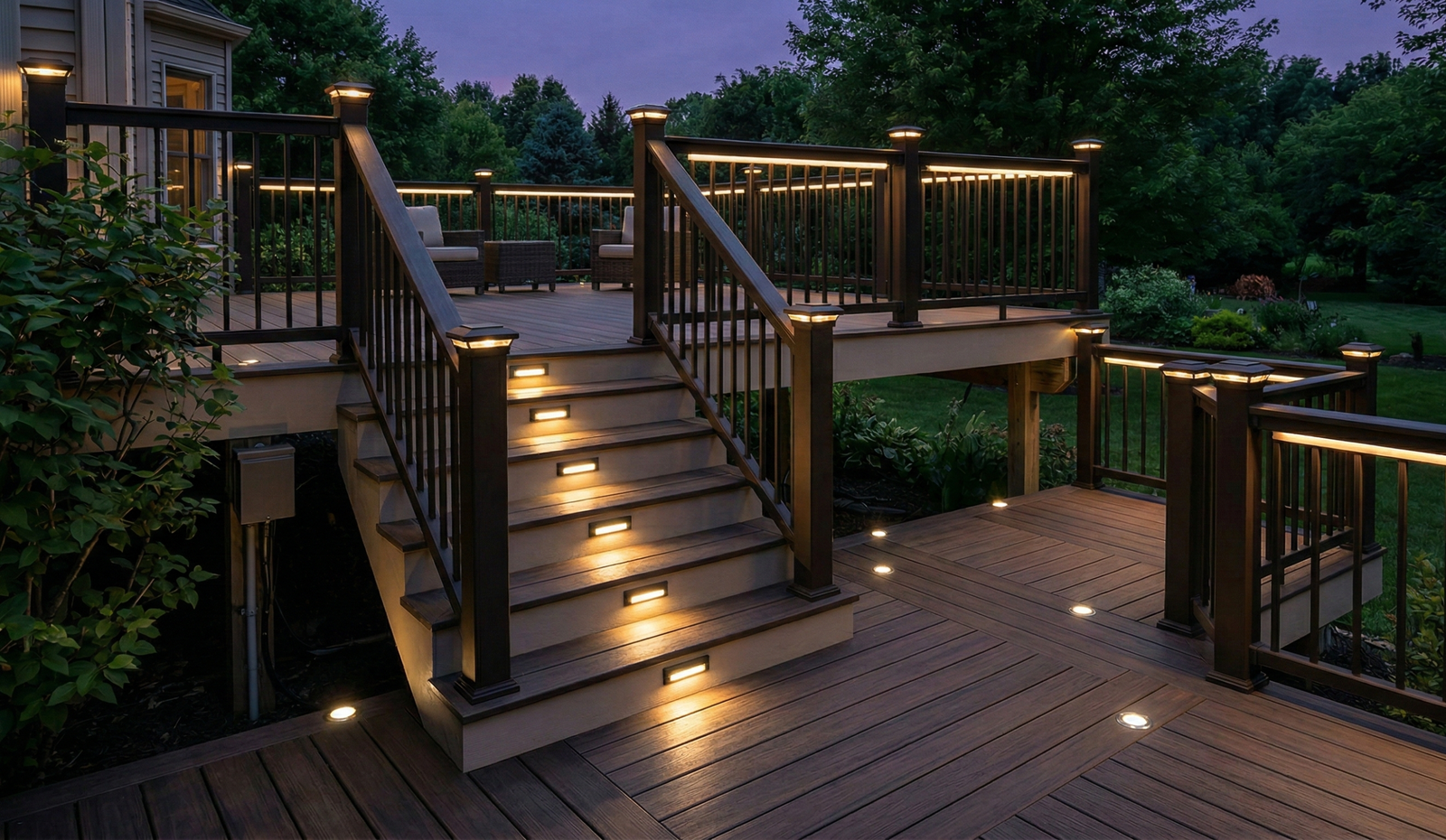
Both types come in a wide range of fixture styles: deck railing lights, deck post cap lights, recessed deck lighting, deck step lighting, and full deck lighting kits designed for whole-deck coverage.
Mounted directly onto railing posts or rails, these fixtures provide ambient downlighting along the perimeter of your deck. Most clip or screw on without tools. Solar models are common here because railings typically receive good sun exposure throughout the day.
Post cap lights sit on top of 4×4 or 6×6 deck posts. They deliver a warm, lantern-like glow and are one of the most popular deck lighting fixtures in the wireless category. Solar-charged versions are especially effective since post tops are rarely shaded. To learn more about why these are a favorite among homeowners, explore the benefits of installing post cap lights.
Recessed deck lighting is flush-mounted into the deck surface or risers, creating a clean, built-in appearance. Wireless recessed lights are typically battery-operated, since their installation location often blocks direct sunlight. Look for IP67 or higher waterproof ratings, and choose units rated for foot traffic if you’re mounting them in the deck surface. If you are looking for inspiration on how these look in real applications, browse our gallery of sleek recessed deck lighting designs.
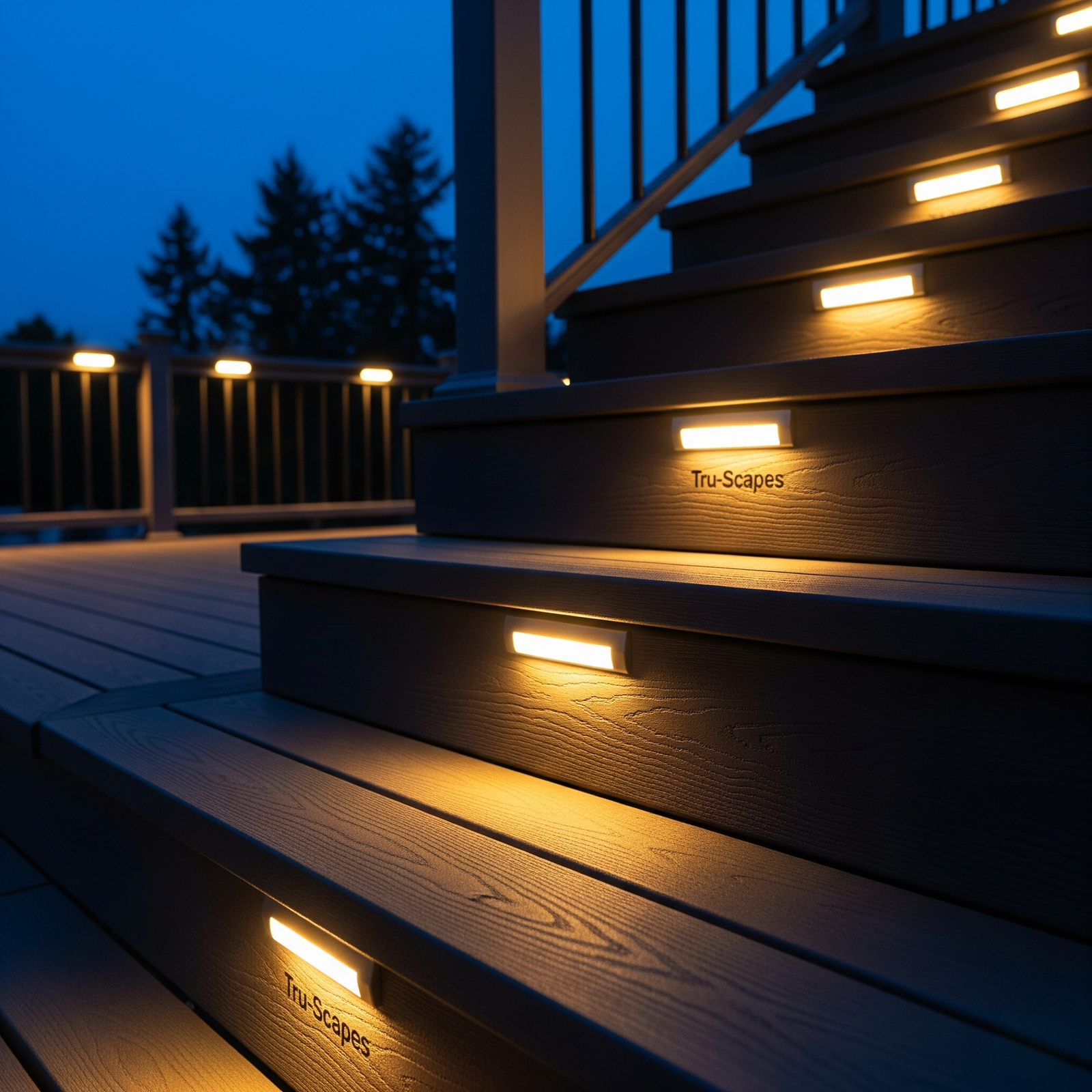
Step lights improve safety by illuminating the edges of each stair tread. These low-profile fixtures mount to the riser (vertical face) of each step. Most battery-operated step light kits include multiple units on a shared remote or timer, making them easy to coordinate as a set. Because falls are a primary concern on decks, read our dedicated resource on ensuring safety with stair lights to ensure your installation meets best practices.
Under deck lighting mounts to the joists or ceiling of the space below an elevated deck — useful when the deck has an enclosed lower level. Because this area is sheltered from direct sun, battery-operated or plug-in wireless systems are more practical than solar here.
All-in-one deck lighting kits typically combine several fixture types — step lights, post caps, and rail lights — in a matched finish. Many are solar-powered with a central panel, while others use battery packs shared across multiple connected fixtures.
| Feature | Wireless Deck Lighting | Hardwired Deck Lighting |
|---|---|---|
| Installation complexity | Low (DIY-friendly) | High (often requires electrician) |
| Installation cost | Low to moderate | Moderate to high |
| Brightness potential | Low to moderate | Low to very high |
| Reliability | Depends on sun/battery | Consistent |
| Flexibility/relocatability | High | Low |
| Long-term maintenance | Battery/panel replacement | Minimal |
| Weather resistance | Varies by product | Varies by product |
| Best for | Accents, ambiance, safety | Primary task/area lighting |
If you need powerful area lighting for hosting large gatherings after dark, hardwired systems will outperform most wireless options. If you need accent lighting, step safety lighting, or post cap aesthetics, wireless deck lighting is a fully capable solution. However, when considering any electrical installation, it is wise to review electrical fire safety statistics from the NFPA to understand the importance of proper component ratings and installation methods.
Step 1: Audit your sun exposure. Walk your deck at midday and note which areas receive 6+ hours of direct sunlight. Those zones are candidates for solar-powered fixtures. Shaded areas will need battery-operated options.
Step 2: Define your lighting purpose. Separate your needs into three categories: safety (steps, edges), ambiance (post caps, rails), and task (dining or cooking areas). Each purpose calls for different brightness levels.
Step 3: Choose your fixture types. Match fixture styles to your deck structure. If you have 4×4 posts, post cap lights are a natural fit. If you have open-riser stairs, step lights are a safety priority. A combination of fixture types — available in deck lighting kits — often produces the best overall result.
Step 4: Check IP ratings. Any outdoor deck lighting fixture must carry at minimum an IP44 rating (splash-proof). For recessed deck lighting set into the surface or under deck lighting in humid environments, look for IP65 or higher. Not sure what these numbers mean? Our guide on choosing weatherproof deck lights breaks down exactly what protection levels you need for your specific climate.
Step 5: Compare lumen output to your needs. Ambiance: 5–15 lumens per fixture. Pathway and step safety: 20–100 lumens. Entertaining/task areas: 100–400 lumens. Most wireless fixtures fall in the lower two ranges.
Step 6: Review battery life and replacement costs. Check the manufacturer’s stated run time per charge or battery set, and factor in the annual cost of battery replacements if applicable. Solar fixtures with lithium batteries typically outperform those with NiMH cells in cold climates.
Step 7: Buy one unit first. Before purchasing a full deck lighting kit, buy a single fixture and test its real-world brightness and run time on your deck for one week. This avoids costly bulk returns.
Do:
Don’t:
If you have a large, sunny deck and want low-maintenance ambiance, solar deck post cap lights and solar rail lights are your best choice. They require minimal upkeep and deliver attractive evening glow with zero operating cost.
If your deck is heavily shaded or in the Pacific Northwest where overcast days are frequent, battery-operated deck lighting kits will deliver more reliable performance than solar options. Budget for annual battery costs.
If you’re primarily focused on safety for young children or elderly guests, prioritize waterproof deck step lighting with at least 30–50 lumens per fixture, installed on every riser.
If you want a finished, built-in look without hiring an electrician, rechargeable battery-operated recessed deck lighting offers the cleanest aesthetic among wireless options.
A homeowner in suburban Nashville with a 400 sq. ft. composite deck wanted to add evening lighting without running electrical. They installed a solar deck lighting kit that included six post cap lights, eight riser-mounted step lights, and four under-rail accent lights. Total installation time: four hours. The solar panels, mounted on two south-facing posts, charged the shared battery pack sufficiently even through a rainy Tennessee spring. The homeowner reported that ambiance lighting met expectations, but they later added a battery-operated string light overhead for brighter entertaining — a common hybrid approach that outdoor lighting professionals often recommend.
What is wireless deck lighting? Wireless deck lighting refers to outdoor deck lighting fixtures powered by solar energy or batteries rather than hardwired electrical connections. They require no wiring into your home’s electrical system.
Are solar deck lights bright enough for real use? Solar deck lights are well-suited for ambiance, step safety, and perimeter accent lighting. They are generally not bright enough for primary task or entertainment lighting, which may require supplemental hardwired or plug-in fixtures.
How long do battery-operated deck lights last per charge? Run times vary widely by product and battery type, but most quality battery-operated deck lights provide 6–12 hours of run time per charge or battery set. Cold weather can reduce this by 20–40%.
What IP rating do I need for deck lights? A minimum of IP44 is acceptable for most deck environments. For recessed deck lighting, in-surface fixtures, or areas with heavy rain exposure, choose IP65 or higher.
Can I use wireless deck lights year-round? Yes, though cold temperatures reduce solar charging efficiency and battery capacity. Look for fixtures rated for your local minimum temperatures, and consider lithium batteries over alkaline in cold climates.
What are deck post cap light sizes? Most deck post cap lights are designed for 4×4 (3.5″ actual) or 6×6 (5.5″ actual) posts. Always verify the actual post dimension — not the nominal size — before purchasing.
How do deck railing lights attach? Most wireless deck railing lights use a clip-on mount, a screw-through collar, or a rail-clamp system. Most installs require no tools beyond a screwdriver.
Are there wireless options for under deck lighting? Yes. Battery-operated LED strip lights or puck lights designed for overhead mounting are commonly used for under deck lighting. Because this area is sheltered from sun, solar is rarely practical here.
Do wireless deck lights need maintenance? Solar deck lights need occasional panel cleaning (dust and pollen reduce efficiency) and eventual battery replacement — typically every 1–3 years. Battery-operated fixtures need periodic cell swaps.
What’s the best color temperature for deck lighting? Warm white (2700K–3000K) is the most popular choice for residential decks. It creates a welcoming, relaxed atmosphere. Cool white (4000K+) is better suited for task or security lighting.
IP Rating (Ingress Protection): A standardized scale that measures how well an electrical enclosure resists the entry of dust and water. For outdoor deck fixtures, IP44 is a minimum; IP65 and above is preferred for exposed or surface-mounted applications.
Lumens: The unit of measurement for the total amount of visible light emitted by a source. Higher lumens means a brighter light. Most wireless deck lighting fixtures output between 5 and 100 lumens per unit.
Photovoltaic (PV) Panel: The solar cell component found on solar-powered deck lights that converts sunlight into electrical energy to charge the fixture’s internal battery.
Color Temperature (Kelvin): A measurement of the warmth or coolness of a light source. Lower Kelvin values (2700K–3000K) produce warm, amber-toned light; higher values (5000K+) produce cool, blue-toned light more similar to daylight.
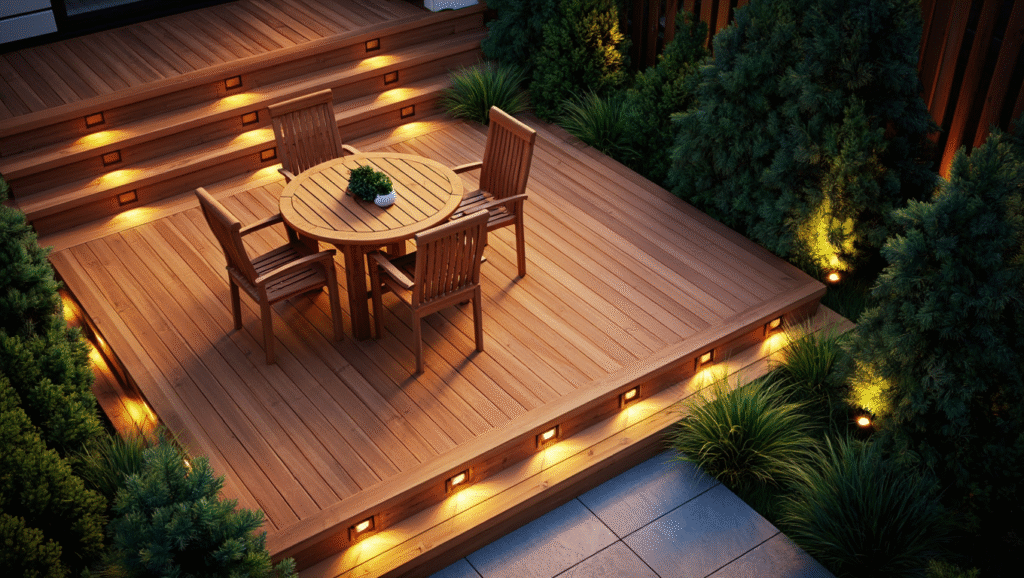
Wireless deck lighting has become a genuinely practical solution for most residential applications — not just a novelty. Whether you’re installing solar post cap lights along a sun-drenched railing or setting up battery-operated step lights on a shaded stairway, today’s fixtures offer real durability, attractive design options, and meaningful energy savings compared to hardwired alternatives.
The right choice comes down to three things: your sun exposure, your brightness needs, and your tolerance for maintenance. Match those factors to the fixture types and power sources covered in this guide, and you’ll end up with an outdoor space that’s safer, more inviting, and genuinely enjoyable well after sunset.
Ready to light up your deck? Start with a single fixture in your most challenging location — shaded, high-traffic, or both — and prove the concept before committing to a full deck lighting kit. Once you’re ready to upgrade, browse our full collection of professional-grade wireless solutions today.
Upgrading your outdoor space doesn’t have to mean hiring an electrician or tearing up your deck boards to run conduit.
The short answer is: it depends. Deck lighting has come a long way. Today you can buy plug-and-play solar deck