- FREE Shipping on all orders! Limited time!
- support@tru-scapes.com


A deck that looks great at 2 p.m. can turn into a trip hazard by 8 p.m. That gap is exactly what good outdoor deck lighting fixes. It extends the hours you actually use the space, and it shows off the woodwork, stone, and railing details you paid for.
This guide focuses on deck lighting Lancaster County homeowners can count on through cold winters, humid summers, and everything in between. You’ll learn 10 design ideas split between rustic and modern styles, how to plan a layout step by step, which deck lighting fixtures work best where, and the mistakes that cost people money.
Lancaster County has a strong design identity. Stone farmhouses, timber barns, and open farmland shape what looks “right” here. Many homeowners want lighting that fits that heritage, while newer builds often lean toward sleek composite decks and black aluminum railings.
Weather matters just as much as style. South-central Pennsylvania sees repeated freeze-thaw cycles, snow, road salt tracked onto steps, and humid summer storms. Fixtures that are fine in a mild climate can crack, fog up, or corrode here within a few seasons.
That’s why wet-location rated fixtures matter more than style. Look for waterproof deck lights listed for wet locations by a recognized testing lab such as UL, and check the IP rating. An IP67 rating means the fixture is dust-tight and can handle temporary immersion, which is useful for recessed fixtures where water can pool. For more tips on surviving the local climate, see our guide on how to winter-proof your lighting.
Rustic lighting works best when the fixtures feel like part of the structure rather than gadgets bolted onto it.
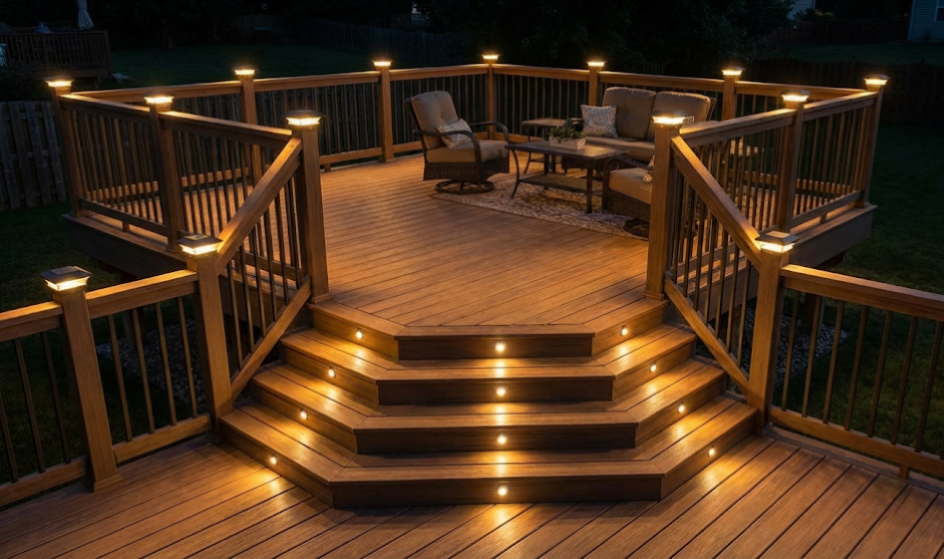
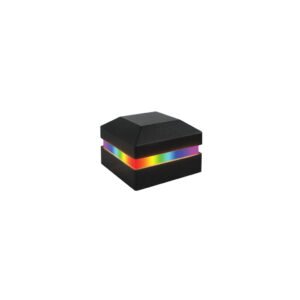
Deck post cap lights sit on top of railing posts and cast a soft glow downward. In oil-rubbed bronze or raw copper, they age naturally and match wood posts and stone accents. They also mark the deck’s outline from across the yard. If you are unsure which style fits your home, check out our complete guide to deck post cap lights.
Small lantern fixtures mounted on posts or the inside of the railing give a farmhouse feel. Choose models with frosted or seeded glass so the bulb isn’t glaring at guests.
Louvered riser lights push light down onto each tread instead of out into people’s eyes. In a dark bronze finish, they blend into stained wood stairs and stone steps.
If you have a patio under an elevated deck, small downlights mounted between joists turn that space into a usable room. Paired with exposed beams, the effect feels like a lit barn bay.
For a casual gathering space, outdoor-rated string lights draped across pergola beams add warmth. Keep them on a dimmer or separate switch so they work as mood lighting, not your main safety lighting.
Modern lighting hides the source and lets the light itself do the work.
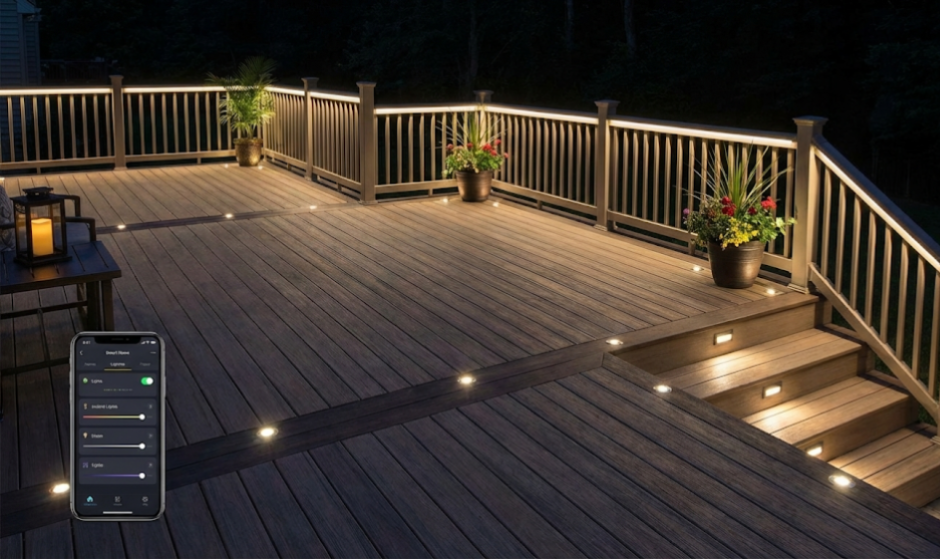
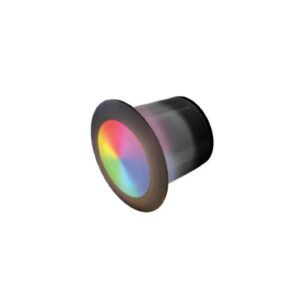
Sleek recessed deck lighting designs sit flush with the decking surface. Small round or square fixtures spaced along a walkway or perimeter create a runway effect that looks clean in daylight too.
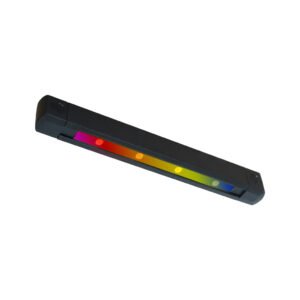
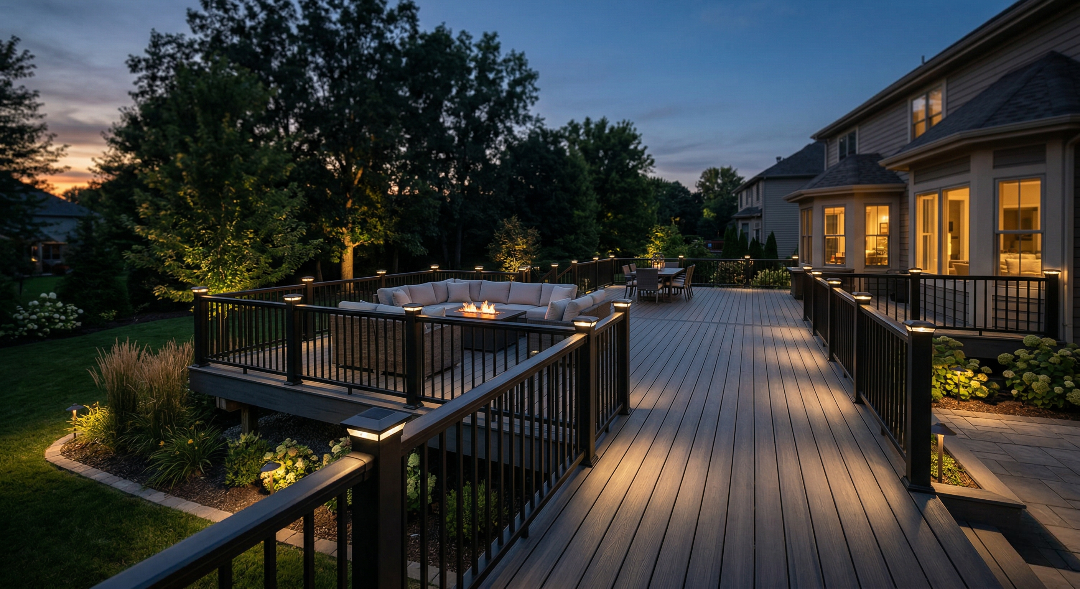
Deck railing lights in the form of continuous LED strips, tucked under the top rail, wash the deck surface in even light. No visible bulbs, no hot spots.
Linear LEDs mounted under each stair nosing make the edge of every step glow. This is one of the safest stair options because it highlights exactly where your foot lands.
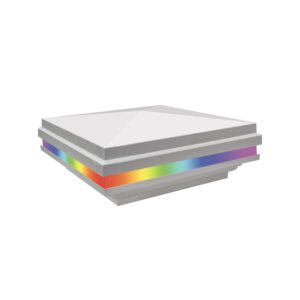
Matte black or brushed aluminum post caps with a simple square profile suit composite decks and cable railings. They add structure at night without looking ornamental.
Splitting your system into zones (stairs, perimeter, accents) lets you run safety lighting all evening and turn on accent lighting only when entertaining. Many low-voltage transformers support timers, photocells, or app control.
| Fixture Type | Best Location | Style Fit | Install Difficulty | Key Consideration |
|---|---|---|---|---|
| Deck post cap lights | Railing posts | Rustic or modern | Easy | Match post size exactly |
| Deck step lighting (riser) | Stair risers | Rustic or modern | Moderate | Needs drilling into risers |
| Recessed deck lighting | Deck surface, perimeter | Modern | Moderate to hard | Requires IP67 rating and drainage |
| Deck railing lights (LED strip) | Under top rail | Modern | Moderate | Use aluminum channel for heat and protection |
| Under deck lighting | Joists over patio | Rustic or modern | Moderate | Plan wiring before soffit or ceiling goes up |
| String lights | Pergolas, overhead | Rustic | Easy | Decorative only, not safety lighting |
If you’re building a new deck, plan wiring during framing. If you’re adding lights to an existing deck, surface-mount options like post caps and railing strips are far less disruptive than recessed fixtures.
Deck lighting kits bundle fixtures, cable, and a transformer in one box. They suit some projects well and fall short on others.
If you have a small, straightforward deck and want basic post and step lighting, a quality kit can be enough. If you have multiple levels, an under-deck patio, or want recessed fixtures, a custom-designed system will hold up better and look more cohesive.
On glare, DarkSky International’s lighting guidelines recommend fully shielded fixtures and warm color temperatures of 3000K or below. That advice also happens to make decks feel more comfortable. To ensure you don’t fall into common traps, review these common deck lighting mistakes to avoid.
A family with a two-level cedar deck and a stone patio underneath. Their main complaint: guests hesitated on the stairs at night, and the patio below went unused after dusk.
The plan started with stair nosing lights on all eight steps and bronze post caps on every railing post. Under the upper level, four small downlights went between the joists over the patio. Everything ran on one low-voltage transformer split into two zones with a timer.
The result: safety lighting comes on automatically at dusk, while the patio lights switch on only when the family is outside. The stairs stop being a hazard, and the patio becomes a second evening space. This is the kind of layered approach that makes deck lighting worth the investment.
A: Low-voltage LED fixtures rated for wet locations perform best in Lancaster County’s freeze-thaw climate. Pair step lighting for safety with post caps or railing lights for ambiance.
A: Yes. Low-voltage systems run at 12 volts, which greatly reduces shock risk compared to standard household voltage. The transformer should still plug into a GFCI-protected outlet.
A: Around 2700K suits rustic decks and creates warm, relaxed light. Around 3000K works well for modern designs while staying comfortable on the eyes.
A: Often yes, but it requires drilling into decking and running cable underneath. Check your decking manufacturer’s guidance first, especially for composite boards.
A: Solar lights can work for decorative accents, but short winter days and cloud cover reduce their output. Wired low-voltage lighting is more reliable for stairs and safety.
A: Most homeowners light every step, or every other step on wide stairs. The goal is that each tread edge is clearly visible.
A: Low-voltage plug-in systems often don’t need one, while new line-voltage circuits usually do. Check with your local municipality, since Pennsylvania’s Uniform Construction Code is enforced locally.
A: Yes. Fixtures exposed to rain, snow, and melting ice need a wet-location listing and a strong IP rating to avoid moisture damage and failures.
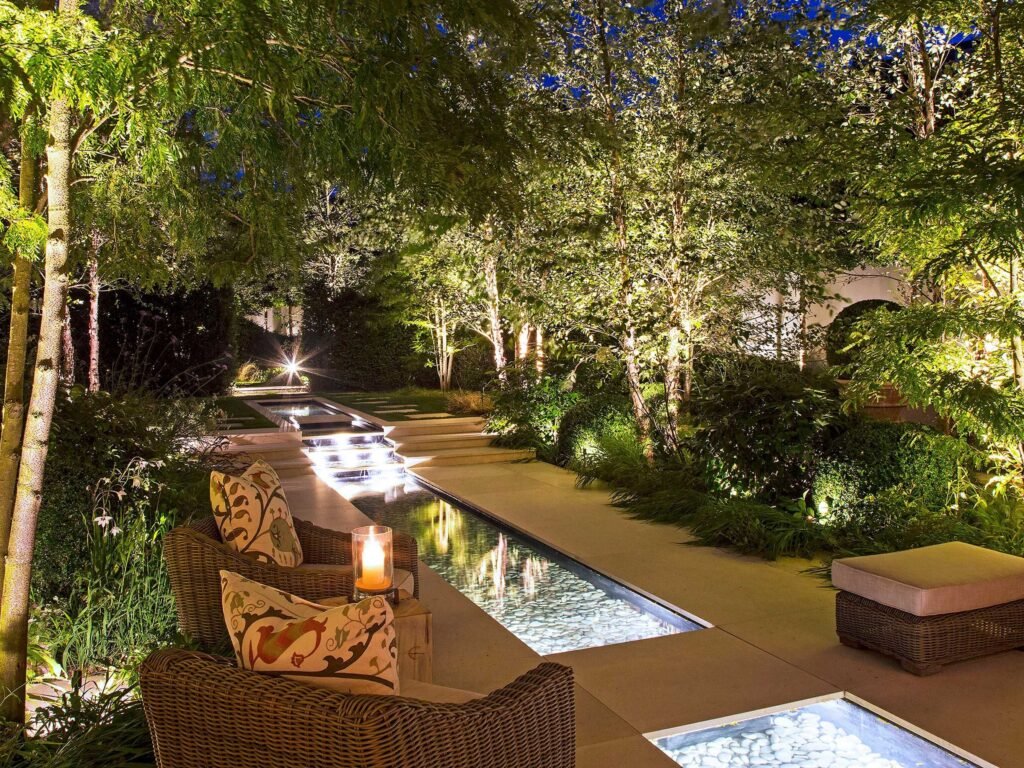
Good deck lighting does three jobs at once: it keeps people safe on stairs and edges, it makes your deck usable well past sunset, and it highlights the materials and design you invested in. Rustic homes shine with warm post caps, lanterns, and louvered step lights. Modern decks look best with recessed fixtures, hidden LED strips, and clean square caps.
Whatever style you choose, start with safety lighting, keep color temperature consistent, and buy fixtures built for Pennsylvania weather. According to the U.S. Department of Energy, switching to LED lighting can significantly reduce energy costs while providing superior longevity. If you want deck lighting Lancaster County neighbors will notice for the right reasons, talk to trusted deck lighting companies in Pennsylvania who can design a layout around your deck, your style, and how you actually use the space.
Key Takeaways A deck that looks great at 2 p.m. can turn into a trip hazard by 8 p.m. That
Key Takeaways A deck that goes dark at sunset is only half a deck. Once the light fades, stairs become