- FREE Shipping on all orders! Limited time!
- support@tru-scapes.com

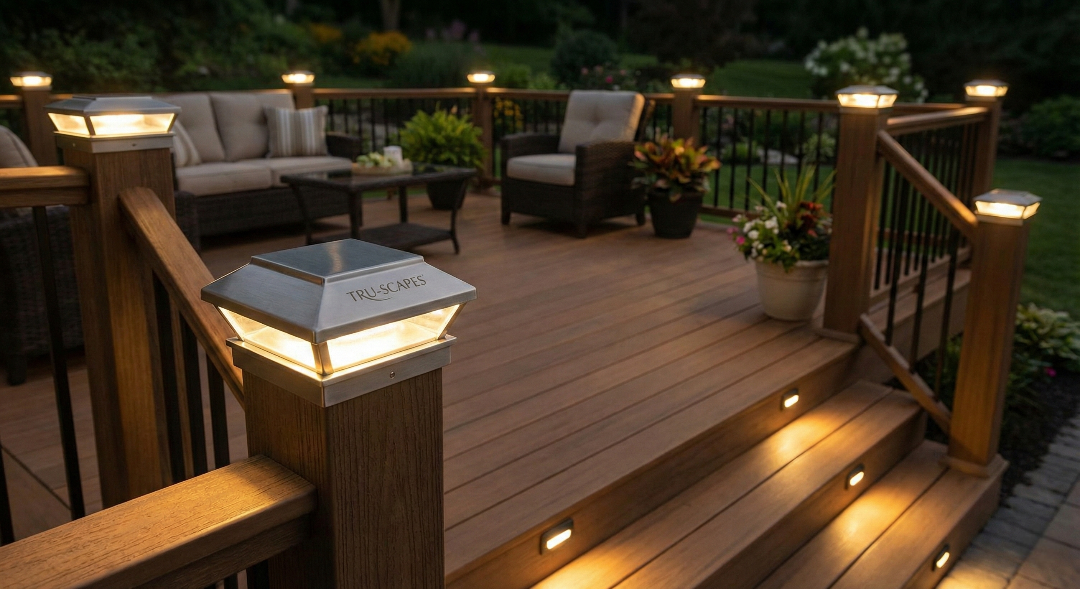
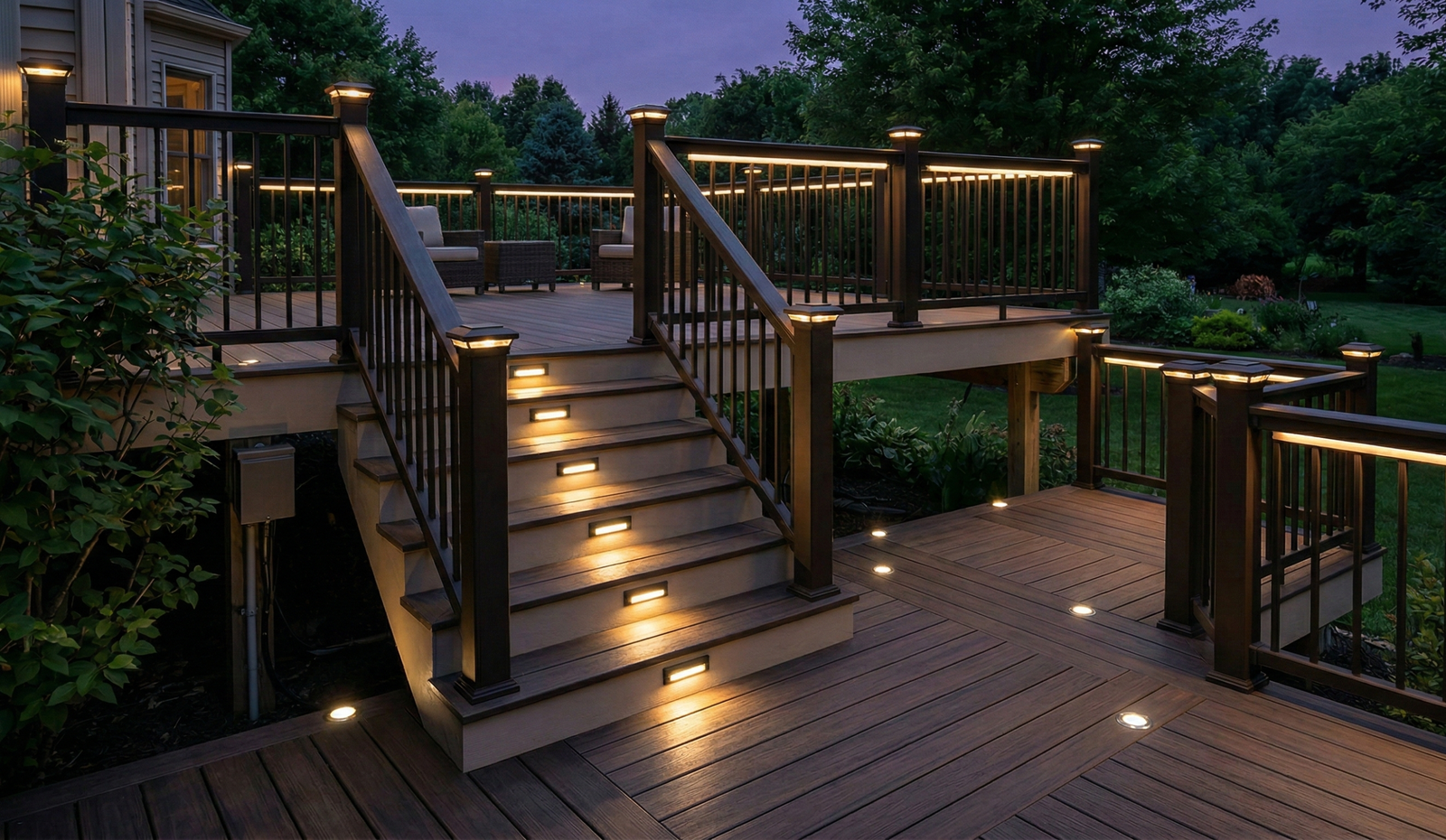
You are standing on your deck, enjoying a quiet evening, when you notice it—that one dark spot in your otherwise perfectly lit backyard. One of your old incandescent bulbs has finally burned out. You head to the garage to grab a replacement, but all you have on hand are those new, energy-efficient LED bulbs. Now you face a common dilemma: is it safe to mix led and incandescent lights on your existing transformer?
It seems like a simple swap. Unscrew the old one, screw in the new one, and flip the switch, right? But then the doubt creeps in. Can you actually run both types of bulbs on the same system? Will it blow the transformer? Will it look terrible?
These are valid questions. As homeowners across the United States look to modernize their outdoor spaces, we see this scenario constantly at Tru-Scapes. You want the efficiency of modern technology without the hassle of ripping out your entire existing infrastructure.
The short answer is: Yes, you can usually mix them, but it comes with some significant “ifs” and “buts.”
In this guide, we are going to walk you through exactly what happens when you mix led and incandescent fixtures, the technical hurdles you need to watch out for, and how to do it safely so your deck continues to look its best.
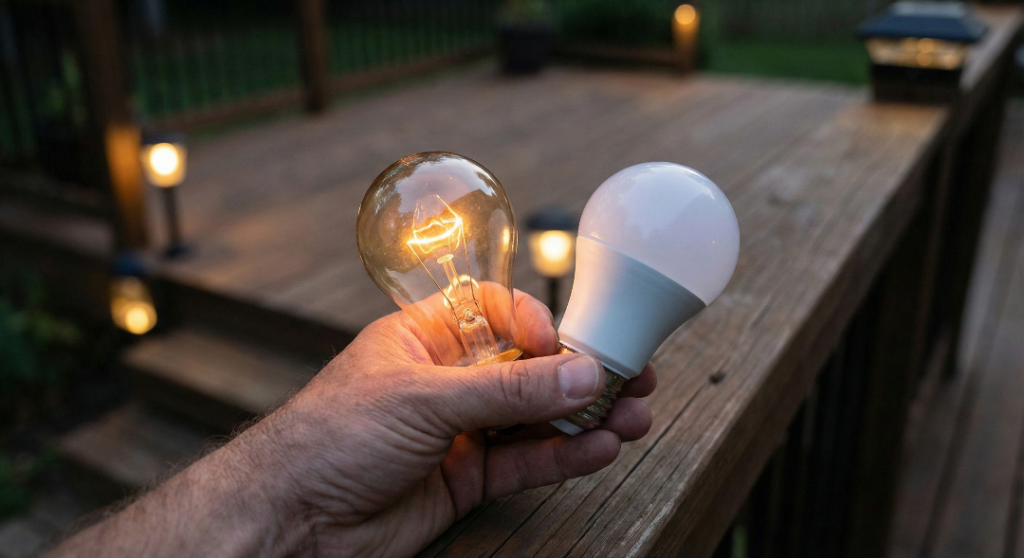
Let’s get the big question out of the way immediately. Technically speaking, mixing LED and incandescent lights on the same low-voltage transformer is possible. Both types of bulbs are designed to operate on the 12-volt current provided by your landscape lighting transformer. The electricity flowing through the wires doesn’t inherently discriminate between the glowing filament of an incandescent bulb and the diode of an LED.
However, just because you can do something doesn’t always mean it will work perfectly on the first try. While the voltage matches, the way these two technologies consume power is vastly different. Incandescents are simple resistive loads—they burn energy to make light (and a lot of heat). LEDs are complex electronic devices that sip power.
When you mix led and incandescent bulbs, you are essentially asking your transformer to manage two very different types of employees. One is hungry and demanding (the incandescent), and the other is efficient but sensitive (the LED). If your system is older, or if you aren’t careful with your math, this mismatch can lead to flickering, buzzing, or reduced lifespan for your bulbs.
The heart of your deck lighting system is the landscape lighting transformer. This box, usually mounted on the side of your house or in a garage, steps down the 120-volt power from your home to a safe 12 volts for your landscape lights.
Transformers generally come in two flavors, and knowing which one you have is crucial to successfully mixing bulbs.
These are the heavy, brick-like transformers found in many older systems. They are basically big spools of copper wire.
These are lighter, smaller, and more common in newer installations. They use circuitry to convert voltage.
Even if your transformer handles the load perfectly, there is an aesthetic challenge to consider. Lighting isn’t just about visibility; it’s about ambiance.
Incandescent bulbs produce a warm, amber glow that we associate with traditional filament lighting. This is typically around 2700 Kelvin on the color temperature scale. As they age, or if there is a voltage drop on the line, they tend to get even warmer and dimmer.
LEDs, on the other hand, are manufactured to a specific color temperature and hold it consistently. If you buy a 3000K LED (a crisp soft white) and put it next to a 2700K incandescent, the difference will be jarring. The incandescent will look yellow or orange, while the LED will look white or even slightly blue in comparison.
Pro Tip: If you must mix them, try to group them. Keep one specific zone or section of the deck all incandescent and another section all LED. Mixing them alternately (one LED, one incandescent, one LED) highlights the color difference and can make your high-end deck look like a patchwork project.
Do you use a dimmer switch for your outdoor lights? This is where mixing technologies gets tricky.
Incandescent bulbs dim linearly. You lower the voltage, the filament cools down, and the light fades smoothly to black. It is simple physics.
LEDs do not dim the same way. They require specific drivers to interpret the dimming signal. If you have a dimmer switch designed for incandescent loads (which most older ones are), your new LED bulbs might flicker, drop out suddenly, or not dim at all.
When you mix led and incandescent on a single dimmer circuit, the results are rarely satisfying. You might slide the dimmer down to 50%, and your incandescent bulbs will dim beautifully to a soft glow, while your LEDs remain at full brightness until they suddenly shut off completely. If dimming is a priority for your outdoor oasis, we strongly recommend sticking to one technology—preferably LED for the best control.
To safely mix these lights, you need to ensure you aren’t overloading your transformer or dropping below the minimum load. Don’t worry, the math is simple.
Every transformer has a maximum wattage rating (e.g., 300 watts).
Safety Rule: We generally recommend not exceeding 80% of your transformer’s capacity to account for voltage fluctuations and cable resistance. In this example, 220 watts is safely under the 80% limit of a 300-watt transformer (240 watts).
However, remember the Minimum Load check for electronic transformers. If you swapped those numbers—using mostly LEDs and only one incandescent—you might drop too low.
Comparison Table: LED vs. Incandescent Load
| Feature | Incandescent Bulb | LED Bulb |
| Wattage (Brightness equivalent) | ~20 Watts | ~3-4 Watts |
| Heat Output | High (Hot to touch) | Low (Cool/Warm) |
| Current Type | Resistive | Electronic/Driver |
| Lifespan | ~1,000 – 2,000 Hours | ~30,000 – 50,000 Hours |
| Impact on Transformer | Heavy load | Light load |
While you can mix them to save money in the short term or deal with a burnt-out bulb quickly, the long-term play for any homeowner should be a full transition to LED.
At Tru-Scapes, we specialize in high-quality, low-voltage LED deck lighting for a reason. Here is why making the full switch benefits you:
1. Massive Energy Savings An LED uses roughly 80-90% less electricity than an incandescent bulb. If you run your deck lights for 6 hours a night, that adds up significantly on your monthly energy bill.
2. No More Changing Bulbs Incandescent bulbs are fragile. A stray soccer ball, heavy vibration from walking on the deck, or just time will break the filament. Our LED fixtures are designed to last for years, often decades, without maintenance.
3. Consistent Voltage Incandescent lights are sensitive to “voltage drop.” The lights at the end of a long wire run will be dimmer than the ones closest to the transformer. LEDs are much better at regulating this. A Tru-Scapes LED fixture at the end of a 100-foot run will look just as bright as the one at the start.
If you are ready to try mixing led and incandescent bulbs on your current system, follow these steps to ensure safety and performance.
Step 1: Inspect Your Transformer Go to your transformer box. Is it magnetic or electronic? Check the label. If it says “Electronic” or “Solid State,” look for a “Minimum Wattage” rating.
Step 2: Check Your Connections LEDs can be sensitive to loose connections. Incandescents might just flicker, but a loose connection can damage an LED driver. Ensure all your wire nuts or connectors are tight and free of corrosion.
Step 3: Install One LED First Don’t swap them all at once. Replace one incandescent with an LED. Turn the system on. Watch it for 5 minutes.
Step 4: Monitor the Heat If you are putting an LED bulb into an older fixture designed for incandescent, make sure the fixture isn’t enclosed too tightly. While LEDs run cool, the electronics inside them hate heat. If the old fixture was designed to trap heat (to keep the incandescent warm), it might cook your new LED prematurely.
Even with the best planning, gremlins can get into the system. Here is what to do if things go wrong.
Problem: The LED lights are flickering (Strobing).
Problem: The LEDs stay on dimly when the switch is off.
Problem: The transformer is buzzing loudly.
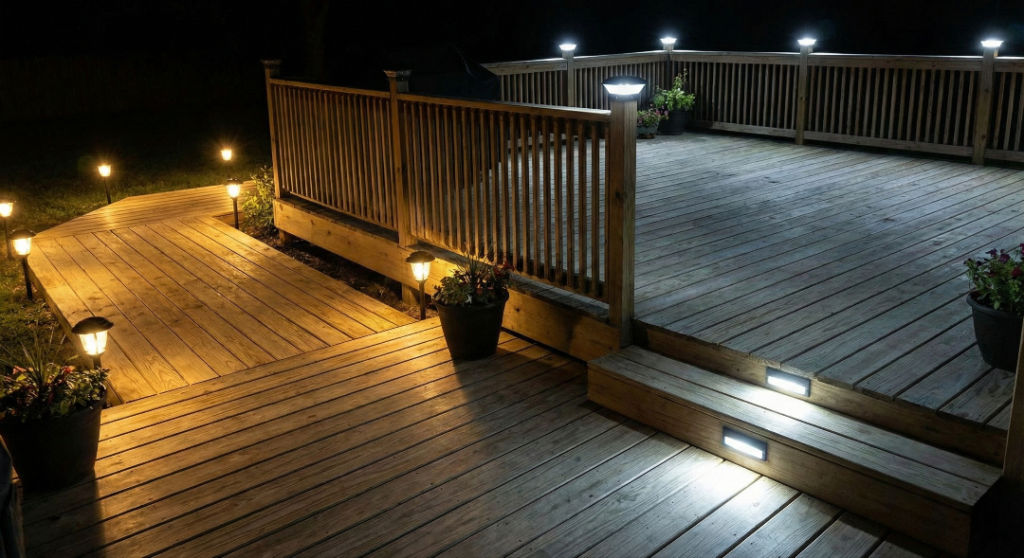
So, can you mix led and incandescent lights on one transformer? Yes. It is a handy solution when you are in a pinch or transitioning your system slowly to spread out the cost. It allows you to keep the lights on without a total system overhaul.
However, think of this as a temporary bridge rather than a permanent destination. The efficiency, durability, and beauty of a fully integrated LED system—like the ones we design at Tru-Scapes—offer a peace of mind that mixed systems simply can’t match. You eliminate the math, the maintenance, and the mismatched colors, leaving you with nothing but a stunningly lit outdoor space to enjoy.
If you are tired of guessing which bulb goes where, or if you are ready to upgrade your transformer to a modern unit that handles your lighting needs with ease, we are here to help.
Ready to stop the flickering and start enjoying your deck? Browse our collection of LED deck lightsand transformers today to find the perfect match for your home.
Upgrading your outdoor space doesn’t have to mean hiring an electrician or tearing up your deck boards to run conduit.
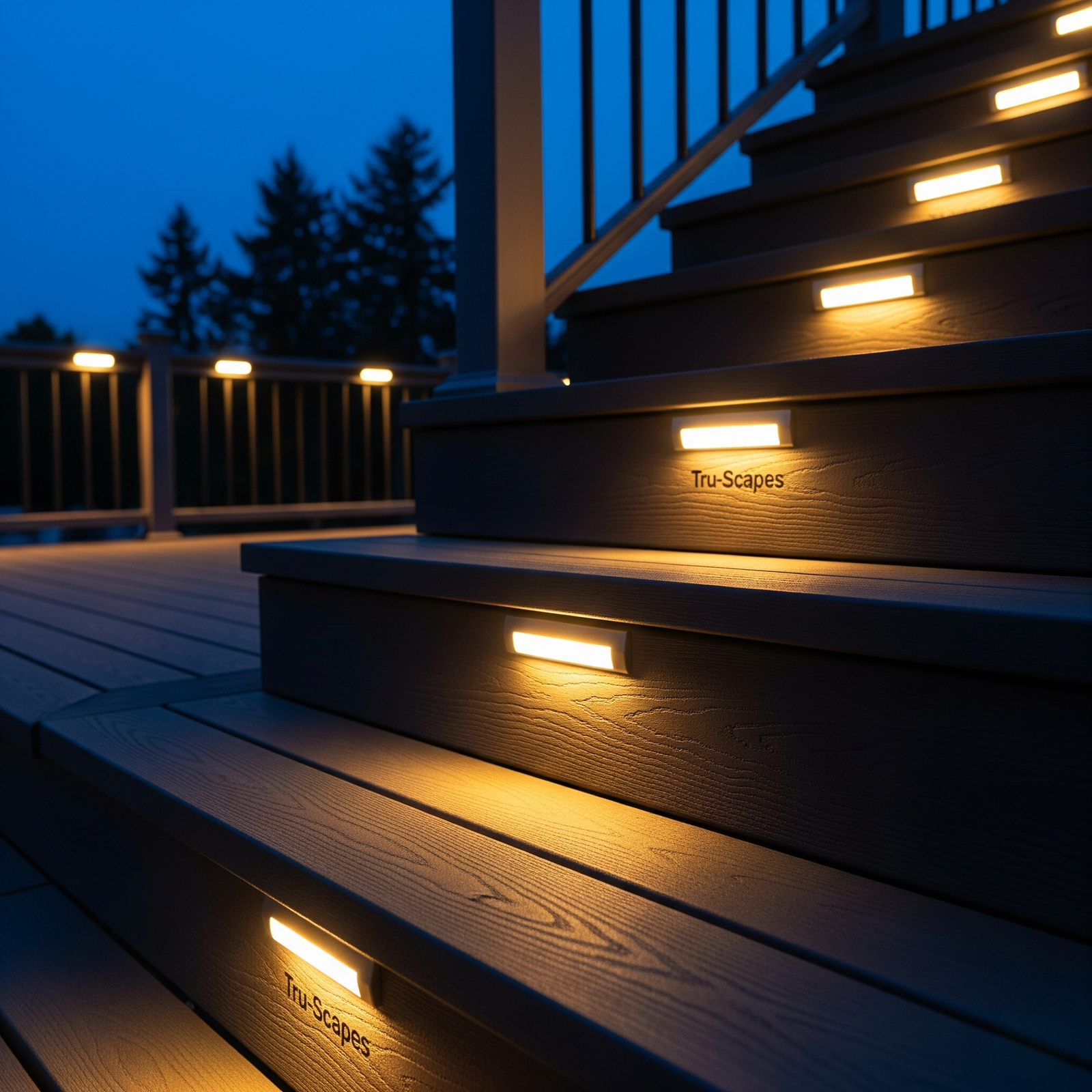
The short answer is: it depends. Deck lighting has come a long way. Today you can buy plug-and-play solar deck