- FREE Shipping on all orders! Limited time!
- support@tru-scapes.com

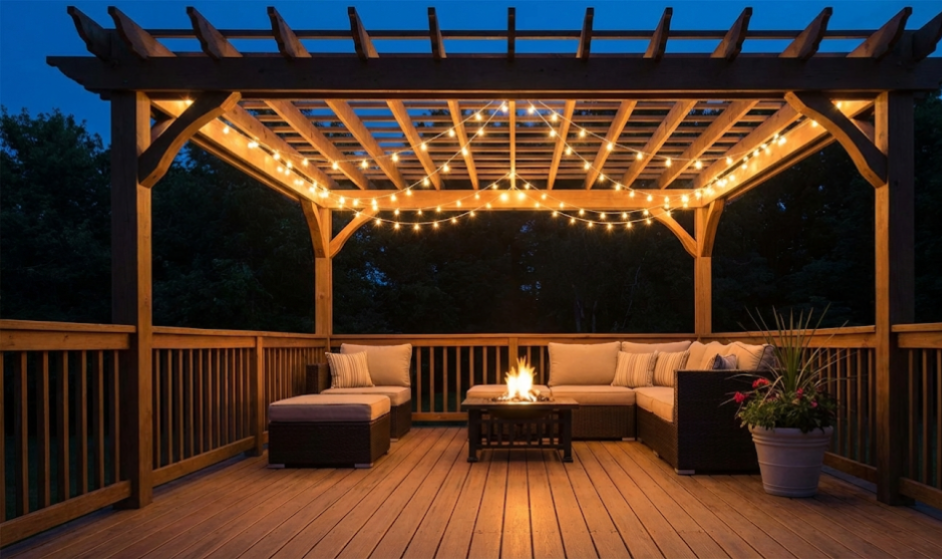
Homeowners ask the same thing before every deck project: are low voltage systems safe around kids, pets, bare feet, rain, snow, and a grill that throws sparks? It is a fair question, because anything involving electricity and an outdoor surface deserves scrutiny.
The short answer is that low voltage systems were designed specifically to remove the hazards people worry about. But “low voltage” is not a magic word, and a sloppy install can still create problems. This guide walks through the actual risks, the ones that are overblown, how the electrical code treats these systems, and exactly how to install outdoor deck lighting so it stays safe for years.
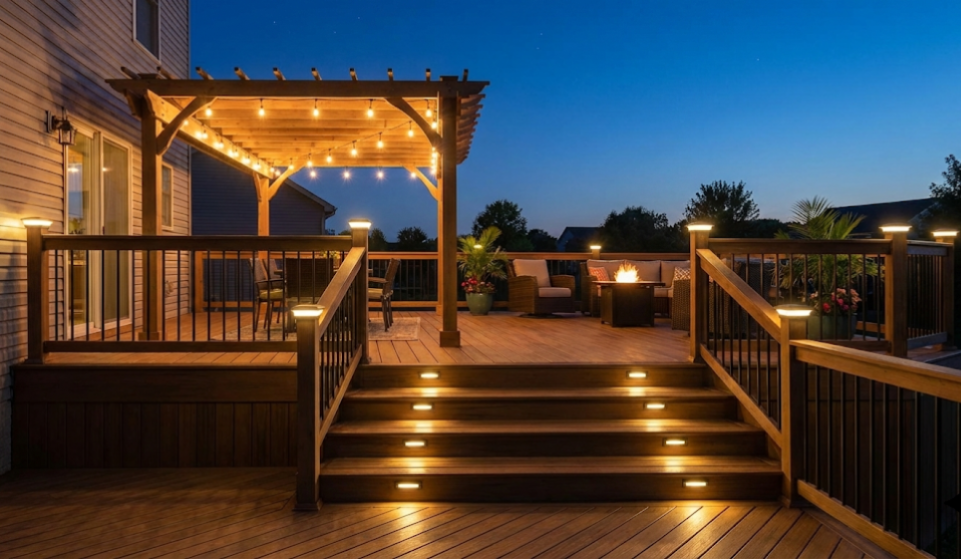
Standard household circuits in the United States run at 120 volts. Low voltage deck lighting runs at 12 volts, sometimes 15V, stepped down by a transformer that plugs into a regular outdoor outlet.
That transformer is the entire safety story in one device. It isolates the lighting circuit from house power and drops the voltage to a level the human body barely registers. Underwriters Laboratories (UL) and the National Electrical Code (NEC) standards both treat these systems as a separate, lower-risk class of wiring for exactly this reason.
Line voltage systems exist too, and they can be perfectly safe, but they demand conduit, junction boxes, and in most jurisdictions a licensed electrician. That is a different project with a different risk profile.
A 12V circuit does not have enough electromotive force to push meaningful current through dry human skin. Touching an exposed low voltage wire typically produces nothing at all. This is why landscape and deck systems are approved for homeowner installation in most areas, while 120V outdoor wiring is not.
The caveat is the transformer itself. It is a 120V device on the input side, and it must be a wet-location model plugged into a GFCI-protected power source.
Fire risk in low voltage systems does not come from the fixtures. It comes from the wire. Undersized cable carrying too much load creates resistance, resistance creates heat, and heat inside a wall cavity or under decking is the actual hazard. The National Fire Protection Association’s guidance on electrical safety reflects this same principle. To avoid this, learn how to wire deck lighting like a pro.
Use the correct gauge for your run length and total wattage and this risk drops to near nothing.
Older halogen deck lighting ran hot enough to burn a hand or scorch nearby wood. LED step and railing fixtures run warm at most. Children can touch them. Bare feet can rest against a recessed deck lighting trim without incident.
This is where most failures actually happen. Water does not create a shock hazard at 12V, but it corrodes connections, kills fixtures, and eventually causes flickering or dead zones. Waterproof deck lights with a proper wet-location listing and sealed connectors solve it. Choosing weatherproof deck lights ensures longevity.
| Factor | Low Voltage (12V) | Line Voltage (120V) |
|---|---|---|
| Shock hazard | Minimal | Significant if damaged |
| Electrician required | Usually no | Usually yes |
| Conduit and boxes | Not required | Required |
| Permit needed | Often no | Typically yes |
| Wire burial depth | Shallow | Deeper, per code |
| Fixture cost | Lower | Higher |
| Best for | Decks, railings, steps, paths | Flood and security lighting |
| Dimming and zoning | Easy | More complex |
If you are lighting a deck surface, railing, or stairs, choose low voltage. If you need a high-output floodlight covering a large yard, line voltage may serve you better.
A homeowner installs a deck lighting kit with 14 recessed lights and six deck railing lights. The kit ships with 18 gauge wire and a 60 watt transformer. Total draw comes to roughly 52 watts, so on paper it works.
Six months later, the lights at the far corner of the deck look noticeably dim and one flickers. Nothing is dangerous, but the system is failing. The cause is voltage drop across a 70 foot run of thin wire, plus a transformer sitting at 87 percent of capacity.
The fix is straightforward. Split the fixtures into two runs off separate transformer taps, upgrade to 12 gauge cable, and replace the corroded connector at the flickering light with a gel-filled splice. Total cost is modest. The lesson is that low voltage systems rarely fail dangerously. They fail dimly, and the warning signs are visible long before anything serious happens. For complex runs, see advanced deck lighting installation tips.
A: Yes. A 12V system cannot deliver a harmful shock through normal contact, and LED fixtures stay cool enough to touch.
A: It is unlikely. Fire risk comes from undersized wire overheating under load, not from the fixtures themselves. Correct gauge wire eliminates the concern.
A: Usually not for a 12V system. You may want one to add the outdoor GFCI outlet the transformer plugs into. Find out if you need an electrician for deck lights.
A: In most jurisdictions no permit is required for the 12V portion. Adding a new exterior circuit or outlet often does. Check your local building department or our deck lighting FAQ.
A: Look for a wet-location listing or a stated IP rating. Marketing language alone is not a standard. Read about premium outdoor lighting fixtures.
A: Yes, provided every fixture and connection is rated for wet locations and the transformer is mounted above grade. See winter-proof deck lighting tips.
A: That is voltage drop. Use heavier gauge wire, shorten the run, or split the load across multiple transformer taps.
A: Quality LED fixtures commonly run for many years of normal seasonal use. Failures are usually connection related rather than diode related. Explore high-quality landscape lighting fixtures.
The device that converts 120V household power down to 12V for the lighting circuit. It is the safety barrier between your house wiring and your deck lights. Read the ultimate guide to low voltage transformers.
The gradual loss of voltage across a length of wire. It causes fixtures at the end of long runs to appear dimmer than those near the transformer. Use our transformer size guide to prevent this.
Ground fault circuit interrupter. An outlet or breaker that cuts power instantly when it detects current leaking to ground, required for outdoor receptacles. OSHA provides federal definitions for GFCIs.
A certification confirming a fixture can withstand direct exposure to rain, snow, and splashing water rather than incidental moisture only. Learn why outdoor lighting fixture quality matters.
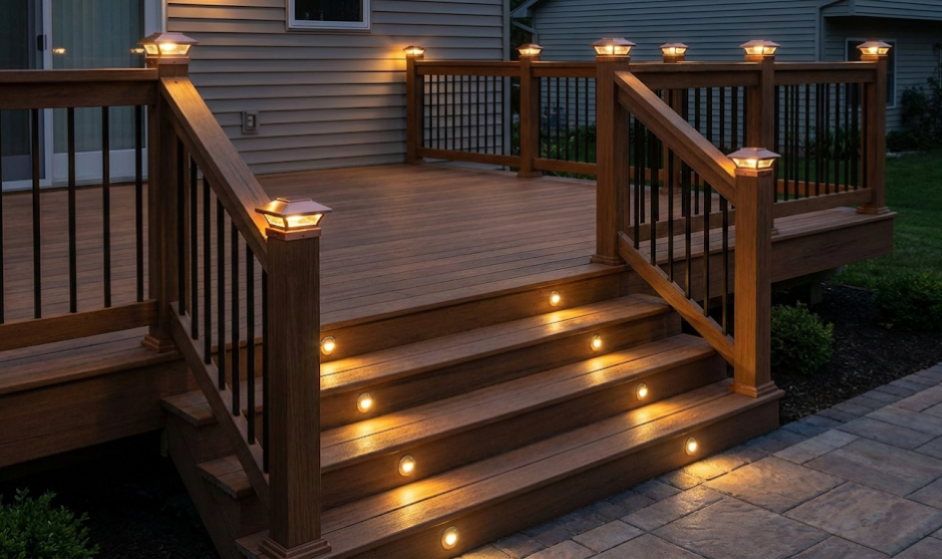
So, are low voltage deck lights safe? Yes, and by a wide margin compared with almost any other way to light an outdoor space. The 12V design removes shock risk, LED technology removes heat risk, and wet-location listings handle the weather.
What remains is workmanship. Size the transformer with headroom, run the right gauge wire, seal every splice, and use components carrying a real listing. Do those four things and your deck lighting will be safe and reliable through many seasons.
If you are planning outdoor deck lighting and want it specified and installed correctly the first time, talk to an experienced lighting specialist who works with these systems every week. A short conversation now prevents the dim corners, corroded connectors, and rework later.
Key Takeaways A deck that goes dark at sunset loses half its value. In Pennsylvania, that problem gets worse, because
Key Takeaways A deck that goes dark at 7 p.m. in October is a deck you only use half the