- FREE Shipping on all orders! Limited time!
- support@tru-scapes.com

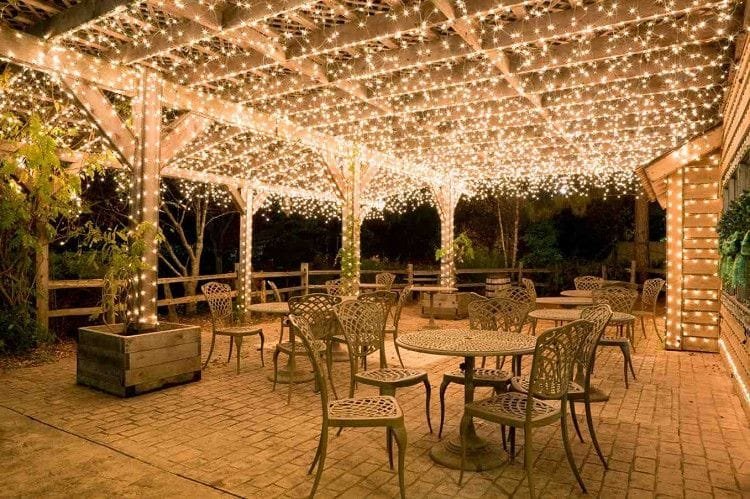
When the sun goes down, a well-lit deck becomes the centerpiece of your backyard. But achieving that effect requires more than scattering a few fixtures around the perimeter — it demands a deliberate approach to placement, fixture type, and coverage. Deck lighting layout ideas that work are the ones that solve real problems: a dark staircase, an undefined railing edge, a post that disappears into the night.
Tru-Scapes engineers their lighting systems specifically for the demands of outdoor deck environments. Whether you’re retrofitting a finished deck or planning lighting into a new build, the principles that guide a great layout are consistent. This guide walks through everything you need to know — from stair riser placement to post cap selection — so your deck works as well at 10 p.m. as it does at noon.

Most homeowners start with fixtures. The smarter starting point is layout.
A beautiful fixture placed in the wrong location contributes little to safety or ambiance. A modest fixture positioned correctly — at a stair riser, anchoring a post, or lining a railing — dramatically changes how a space feels and functions. Outdoor lighting designers and electrical safety organizations consistently note that the majority of nighttime deck injuries occur on stairs and transitions between levels. That makes stair lighting the non-negotiable foundation of any solid layout plan.
From there, lighting strategy expands outward: posts define the boundary of your deck; railings guide movement along its perimeter; accent fixtures on walls or under benches add depth and dimension. Together, these layers create what designers call a “lighting zone hierarchy” — a structured approach where each fixture type serves a specific visual and functional role.
Stairs represent the most-used transition point on any multi-level deck. They also carry the highest safety risk when poorly lit. Any effective set of stair lighting ideas treats each step as its own lighting challenge: the riser (the vertical face of each step) needs enough illumination to define the edge clearly without creating glare for anyone descending.
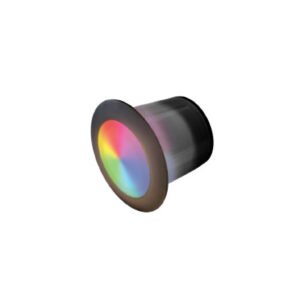
The Tru-Scapes® 6″ LED Deck Step Riser Light is purpose-built for this application. Its low-profile housing sits flush with the riser face, eliminating the protrusion that causes kicks and snags in high-traffic stair environments.
Post cap lights serve a dual function that no other fixture type replicates. They anchor the visual perimeter of the deck and provide ambient downlight across the deck surface simultaneously. In any thoughtful set of outdoor deck lighting design principles, post lighting is treated as the structural layer — the framework onto which all other lighting decisions are built.
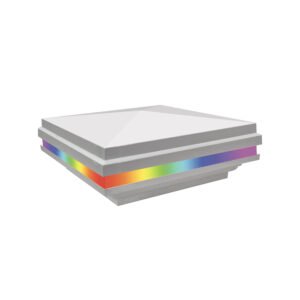
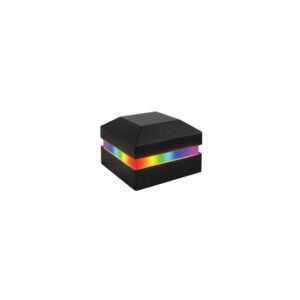
The Tru-Post® 103 LED Deck & Fence Post Light is designed for 4×4 post installations on both decks and fencing. Homeowners who choose Tru-Scapes for their deck post cap lighting benefit from a fixture that’s engineered to resist the thermal cycling that causes cap lights to crack, fog, or fail after their first winter. To ensure longevity, look for fixtures that meet strict IP rating benchmarks for moisture and dust resistance.
Railing lights for decks perform the visual function of defining the edge of the deck — the boundary between usable surface and open air. In layouts with multiple zones, railing lights serve as connective tissue, linking post caps at the corners to stair lighting at the transition points.
There are two primary installation approaches:
| Approach | Best For | Fixture Type |
|---|---|---|
| Under-rail mount | Low-profile, clean aesthetic | Dot lights, puck lights |
| Vertical riser mount on balusters | Higher visibility, stronger safety signal | Surface-mount sconces |
| Rail cap surface mount | Illuminating the rail walking surface | Flat strip or dot lights |
| Post-integrated railing light | Combined post + rail aesthetic | Cap lights with diffused sides |
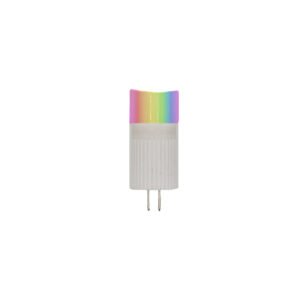
If you need a subtle accent that doesn’t compete with post cap fixtures, the Tru-Scapes® 2.5″ Modern Dot Light delivers precisely that. Tru-Scapes engineers their dot light series with color-changing capability, giving homeowners flexibility to shift from warm white for everyday use to dynamic color for entertaining.
A deck lighting layout that relies entirely on downlighting from post caps produces a flat, uniform illumination that lacks dimension. Wall and sconce fixtures introduce a mid-height light source that creates shadow depth, defines vertical surfaces, and provides wayfinding light along house walls, privacy screens, or pergola uprights.
Sconce placement is guided by the same principle as post cap placement: identify the structural elements first, then work outward. A sconce mounted beside a sliding door, for example, serves both as an architectural accent and as practical task lighting for anyone entering or exiting.
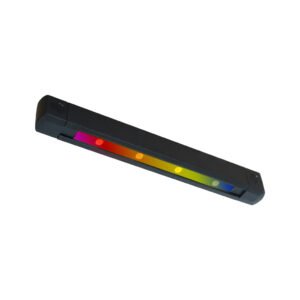
The Tru-Scapes® Low Profile Post / Wall Mount Sconce is built for exactly this application. Its low-profile housing sits close to the mounting surface, making it appropriate for tight spaces where a bulky sconce would feel out of proportion with the architecture.
| Zone | Primary Function | Fixture Type | Coverage Priority |
|---|---|---|---|
| Stair Risers | Safety, edge definition | LED step riser lights | Every riser on travel paths |
| Post Caps | Perimeter definition, ambient light | Post cap LED fixtures | All corner posts; intermediate every 8 ft |
| Railing | Edge guidance, accent | Dot lights, sconces | Along full railing runs |
| Walls/Sconces | Depth, wayfinding | Surface-mount sconces | Entry points, vertical surfaces |
| Pros | Cons |
|---|---|
| Layered zones create depth and visual interest | More fixture types = more complex wiring plan |
| Stair-first layouts prioritize safety correctly | Requires careful transformer load calculation |
| Low-voltage LED systems are energy efficient | Initial planning takes more time than a simple string light run |
| Consistent fixture families create a cohesive look | Mixing brands can produce color temperature mismatches |
| Post cap lights provide ambient light without additional surface fixtures | Post caps alone leave stairs and railings poorly defined |
| Do | Don’t |
|---|---|
| Run wire chases before decking is complete | Retrofit wire through finished composite or hardwood decking |
| Use fixtures from a unified product family | Mix fixture color temperatures across zones |
| Size your transformer for 20% more load than your fixture total | Run a transformer at maximum rated load — it shortens lifespan |
| Light every stair riser on a primary travel path | Skip alternate risers to reduce fixture count |
| Plan for a dedicated circuit for deck lighting | Piggyback deck lighting onto an existing household circuit |
| Choose fixtures rated for wet location or direct burial | Install dry-rated fixtures on exterior decks |
A homeowner with a two-level composite deck — upper entertaining area, lower grade-level patio — approached their contractor with a recurring problem: the stairs connecting the two levels were completely invisible after dark, and the upper deck felt disconnected from the lower space once the sun went down.
The solution used a layered Tru-Scapes approach. Every riser on the connecting staircase received a Tru-Scapes® 6″ LED Deck Step Riser Light, creating a clear, continuous visual path from the upper level to the lower patio. Tru-Post® 103 post cap lights anchored each of the six corner and intermediate posts on the upper deck, casting ambient downlight across the decking surface. Along the railing run facing the yard, Tru-Scapes® 2.5″ Modern Dot Lights were under-mounted at 24-inch intervals, defining the edge without cluttering the sightline.
The result was a deck that felt intentional and safe at night — not simply “lit up.” The contractor noted that the consistent fixture family made wiring straightforward, and the homeowner reported that the deck became their primary outdoor space for evening use within weeks of completion.
| Feature | Low-Voltage LED | Solar | Line-Voltage (120V) |
|---|---|---|---|
| Installation complexity | Moderate | Low | High (licensed electrician required) |
| Fixture selection | Wide | Limited | Wide |
| Performance consistency | High | Weather-dependent | High |
| Suitability for stairs | Excellent | Poor (light output varies) | Excellent |
| Best for | Whole-deck lighting systems | Accent and supplemental only | Permanent architectural installs |
If you need reliable, consistent illumination on stairs and railings, low-voltage LED is the clear choice. Solar fixtures cannot guarantee the output consistency required for stair safety applications. For more on the science behind LED longevity, refer to resources from the U.S. Department of Energy.

The 6″ riser light is engineered for flush installation on the vertical face of deck stairs. Its housing profile eliminates protrusion into the stair travel path, and its LED array delivers consistent output across the full width of the tread above. Built for low-voltage systems, it integrates with standard Tru-Scapes transformer setups without modification
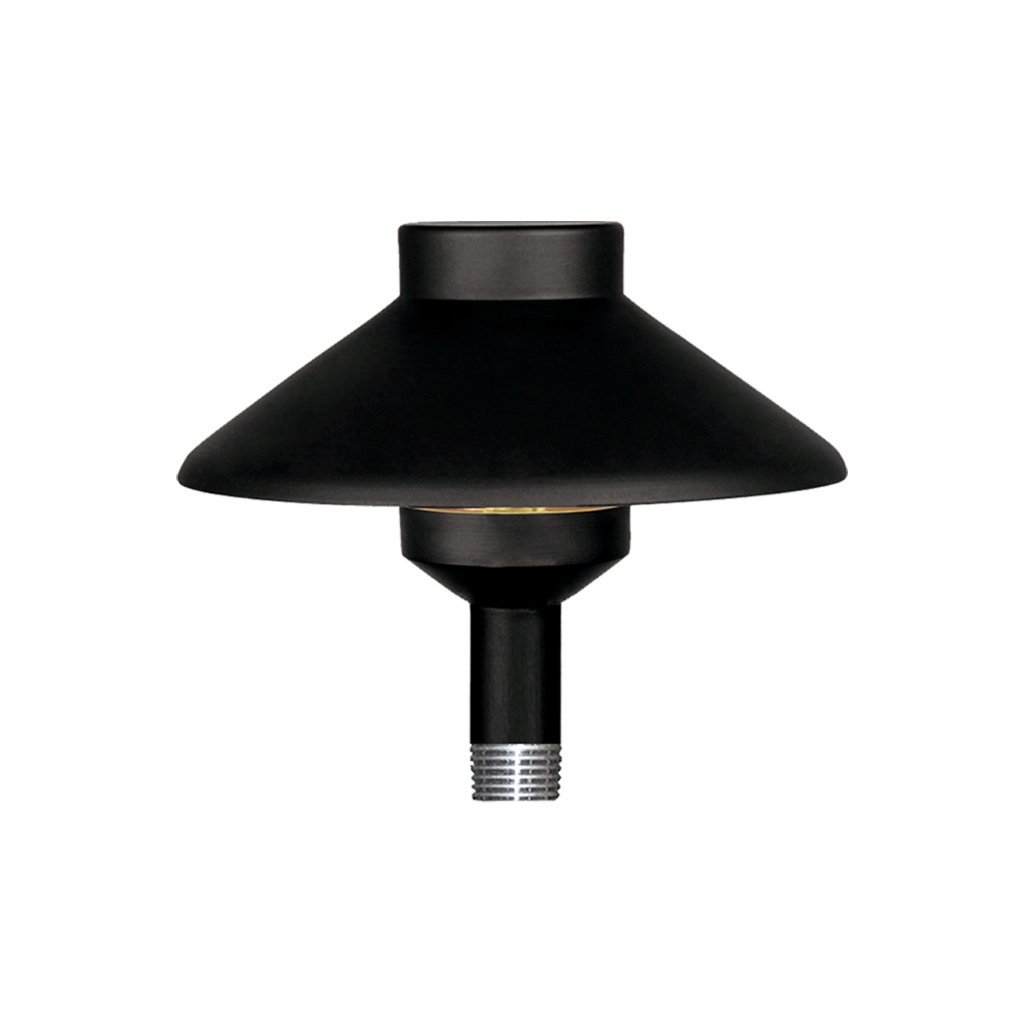
Designed for 4×4 post installations across both deck and fence applications, the Tru-Post® 103 delivers ambient downlight that defines the perimeter of any outdoor structure. Tru-Scapes engineers this fixture to withstand the freeze-thaw cycles common across the Mid-Atlantic and Northeast, where temperature swings are the primary cause of post cap failure.
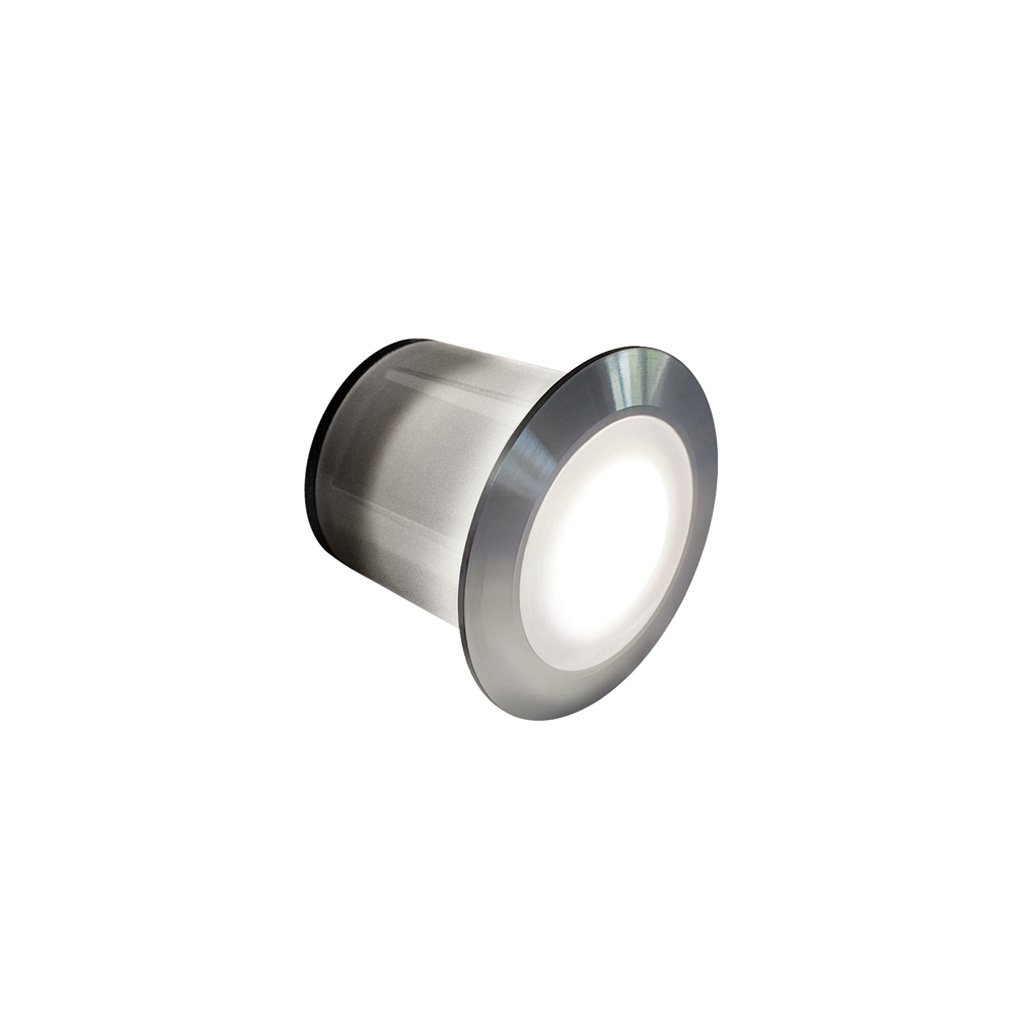
The 2.5″ Modern Dot Light is the versatile accent fixture in the Tru-Scapes lineup. Its compact profile suits under-rail mounting, railing face installation, and surface accenting on deck boards or risers. The color-changing capability allows homeowners to shift output for different occasions — warm white for dinner evenings, dynamic color for entertaining — without changing fixtures.
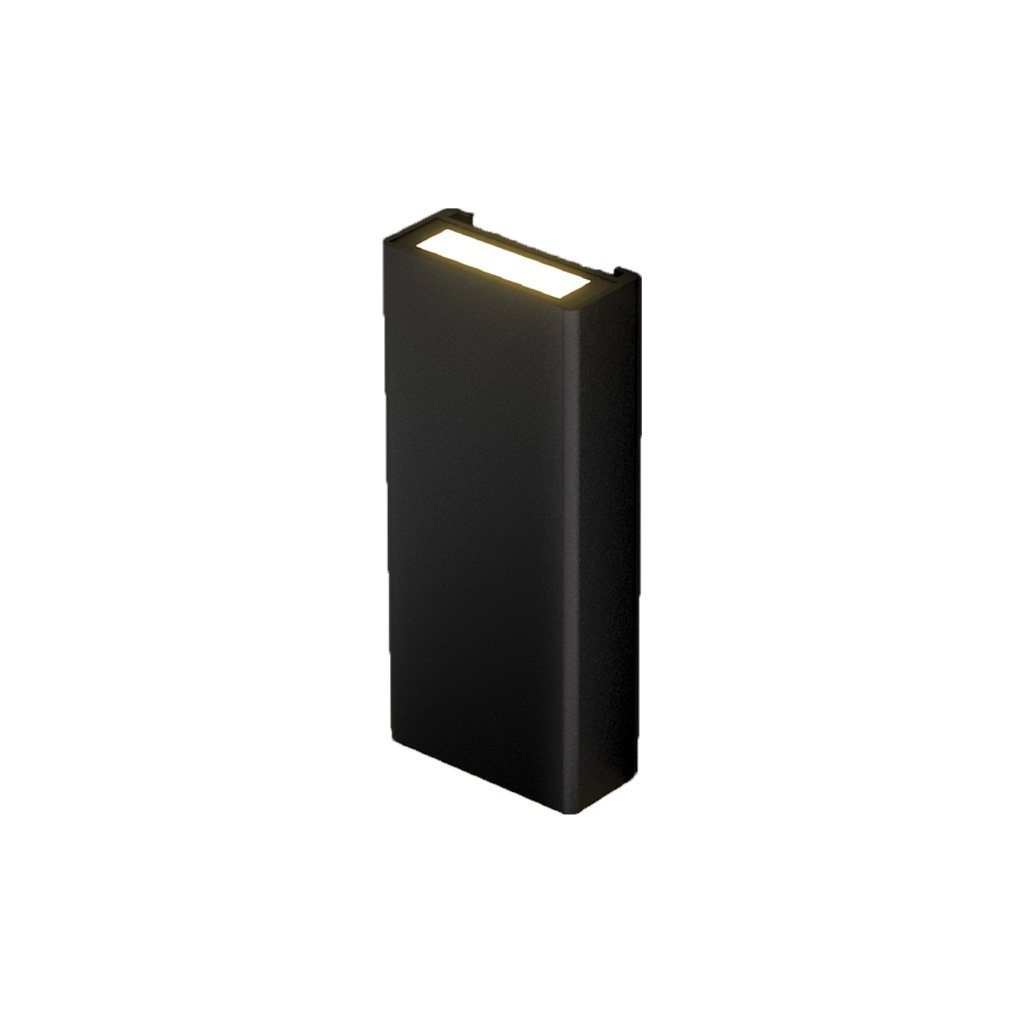
The Low Profile Sconce fills the mid-height zone that post cap lights and stair risers leave open. Its flush-mount housing makes it appropriate for installation beside entry doors, along privacy screens, or on pergola uprights where a bulkier fixture would feel disproportionate. The low-profile build also reduces wind loading on taller mounted positions.
Deck lighting is a long-term commitment. The fixtures you install today will be asked to perform through years of UV exposure, precipitation, freeze-thaw cycling, and the sustained electrical load of a low-voltage outdoor system. That’s the environment Tru-Scapes engineers for — not showroom conditions, but real-world outdoor performance.
The Tru-Scapes approach to outdoor deck lighting design begins with fixture engineering, not just aesthetics. Each product in the lineup — from the Tru-Scapes® 6″ LED Deck Step Riser Light to the Low Profile Wall Sconce — is built with housing and LED assemblies rated for wet-location outdoor exposure. Color temperatures are matched across the product family so that mixing stair risers, post caps, and dot lights on the same deck produces a cohesive, intentional look rather than a patchwork of mismatched sources.
Homeowners who choose Tru-Scapes also benefit from a product line designed for contractor-friendly installation. Consistent wire connection standards across fixtures mean that a deck builder or lighting installer doesn’t need to adapt their process to each fixture type. The result is cleaner installs, fewer callbacks, and a finished deck that performs the way the homeowner envisioned from the first evening forward.
A: Every riser on a primary travel path should have its own fixture. For most residential decks with standard 7-inch risers, one fixture per riser centered on the riser face provides adequate tread coverage. Stairs wider than 48 inches may need two fixtures per riser or alternating offset placement to eliminate center shadows.
A: On a compact deck, prioritize stair lighting and corner post caps first. Two or four post cap fixtures anchor the space, while stair risers handle the safety function. Railing dot lights can be added along one or two sides for accent without overwhelming a smaller footprint.
A: Yes — and this is one of the core advantages of using a unified product family. The Tru-Scapes® 2.5″ Modern Dot Light, the Tru-Post® 103, and the 6″ Step Riser Light are all designed to operate on the same low-voltage system with matched color output, so mixing them across a deck produces a coherent finished result.
A: Map your fixture locations before any decking material is installed. Run conduit or wire chase through the framing at each fixture location, then pull wire after framing is complete and before surface material goes down. Learn how to plan your wiring layout professionally to avoid costly retrofits. Retrofitting wire through finished composite or hardwood decking is significantly more labor-intensive and often requires removing boards.
A: Wet-location fixtures are rated for direct water exposure — rain, irrigation spray, or hose-down cleaning. Damp-location fixtures are rated for condensation and humidity but not direct water contact. Stair risers and outdoor railing applications should always use wet-location rated fixtures to ensure safety and longevity.
A: Add up the wattage of every fixture in your layout, then size your transformer for at least 20% more than that total. Running a transformer at maximum rated capacity shortens its operational life. If you plan to add fixtures later, account for that load in your initial sizing.
A: Low-voltage LED fixtures have significantly longer operational lifespans than incandescent or halogen alternatives. Routine maintenance is limited to keeping lens faces clean and checking wire connections annually. Tru-Scapes engineers their fixtures with sealed housings that minimize moisture intrusion — the primary cause of LED failure in outdoor applications.
A: Avoid placing fixtures in locations where they create direct glare into seated sightlines — a post cap at eye level for someone seated at a dining table, for example. Also avoid placing fixtures where they will be regularly impacted by furniture movement, foot traffic, or equipment storage.
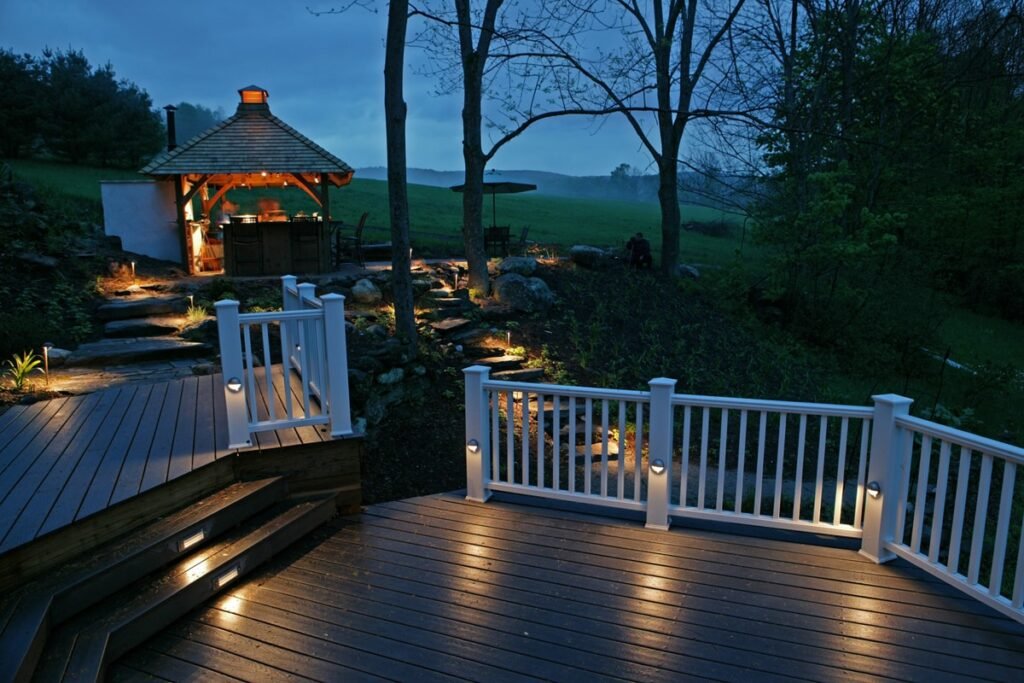
A great deck lighting layout isn’t about the number of fixtures — it’s about placing the right fixture in the right zone for the right purpose. Stair risers establish safety. Post caps define the perimeter. Railing lights guide movement. Wall sconces add depth and wayfinding. When these four layers work together, an outdoor deck becomes a genuinely usable, visually coherent space after dark.
Tru-Scapes builds each product in their lineup to perform within this framework. If you’re ready to move from a dark perimeter to a fully realized outdoor lighting plan, start with the Tru-Scapes® 6″ LED Deck Step Riser Light for your stairs and build outward from there. The result will be a deck that earns its place as the best room in your home — regardless of the hour.
Color-changing outdoor lights have a reputation problem. Done poorly, they turn a beautiful backyard into something that looks like a
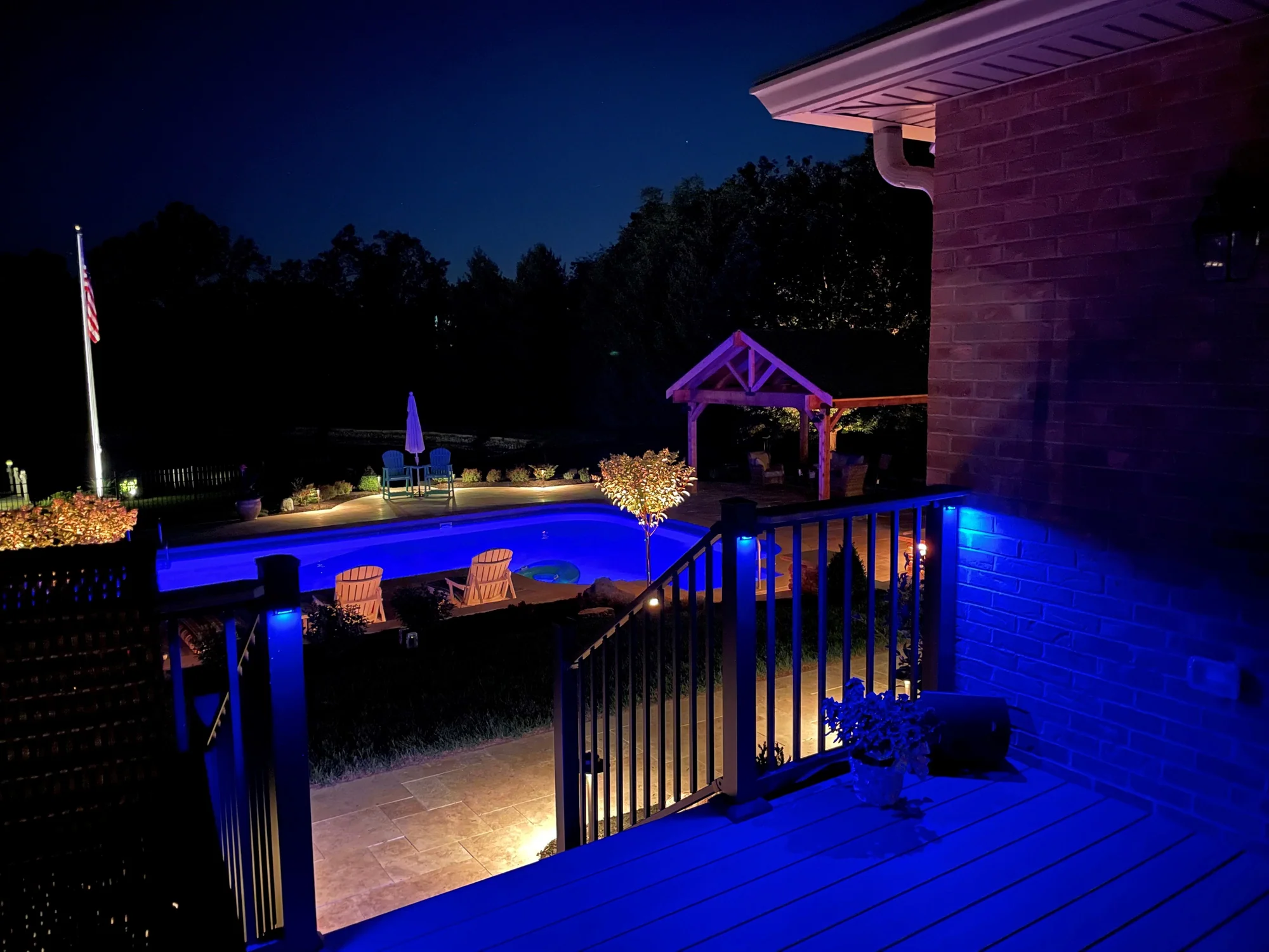
Outdoor spaces have quietly become the heart of the American home, and color-changing deck lights are leading the shift from