- FREE Shipping on all orders! Limited time!
- support@tru-scapes.com

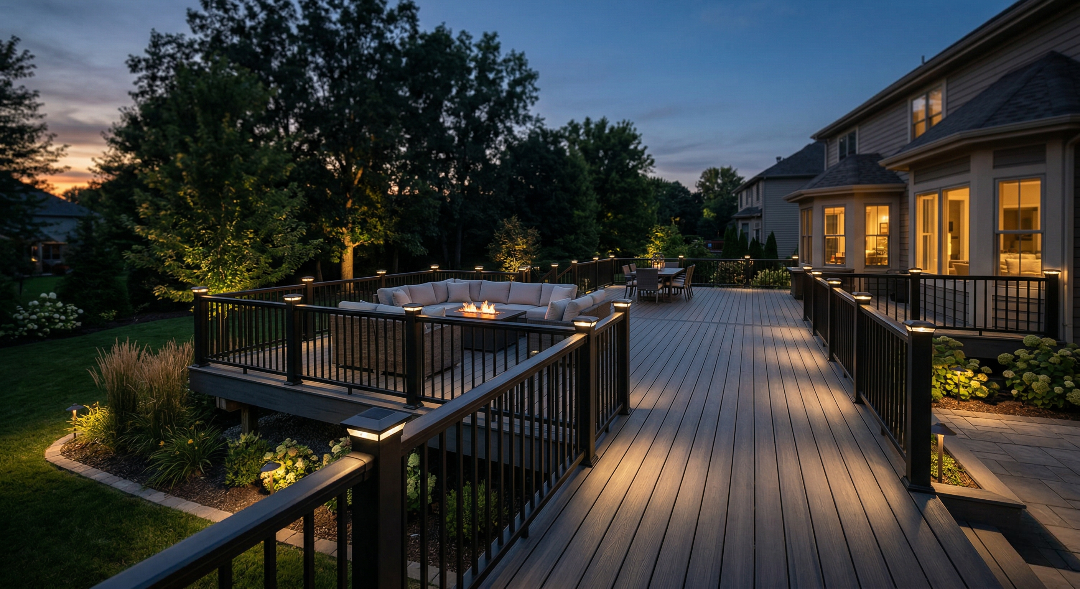
Getting deck lighting right takes more than picking a fixture and hoping for the best. The central question — how many lumens do you need — depends on what each part of your deck is actually used for. A staircase requires different brightness than a lounge area. A dining zone needs different output than a perimeter accent. Get it right, and your outdoor space feels intentional and inviting. Get it wrong, and you’re either squinting at a floodlit patio or tripping over steps in the dark.
This guide breaks down lumen requirements by zone, explains the key lighting types for outdoor decks, and gives you the practical numbers you need to shop with confidence. Whether you’re installing deck step lighting, under deck lighting, post cap lights, or a full deck lighting kit, you’ll find clear, actionable guidance here.
A lumen is the standard unit of visible light output from a source. It measures how much total light a fixture emits, regardless of the direction it points. This is different from watts, which measure energy consumption, not brightness.
Why this distinction matters: A 10-watt LED can produce anywhere from 800 to 1,100 lumens depending on its efficiency. Shopping by watts alone will leave you with inconsistent results. Always check the lumen output on the fixture specification sheet before purchasing. For more on energy efficiency data and lumen output, refer to the U.S. Department of Energy.
For outdoor deck lighting fixtures, lumen counts vary widely by type and purpose. Understanding the difference between ambient, task, and accent lighting will help you apply the right lumen range to each area of your deck.
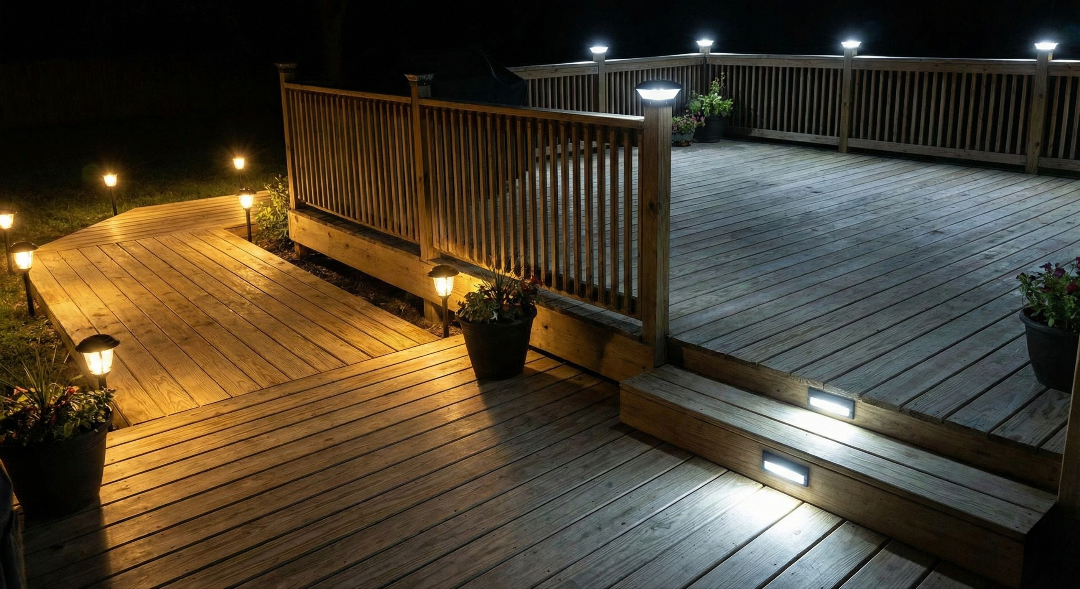
Ambient lighting sets the mood for the entire deck. It’s typically diffused, gentle, and spread evenly. If you need a general seating or dining space, choose fixtures in the 200–400 lumen range placed every 6–8 feet. Sources like post cap lights and deck lighting kits are ideal for this role.
Task lighting serves functional areas: outdoor kitchens, grilling stations, and workspaces. These zones need 400–700 lumens per fixture depending on the surface size. Recessed deck lighting works particularly well here because it illuminates surfaces directly without glare.
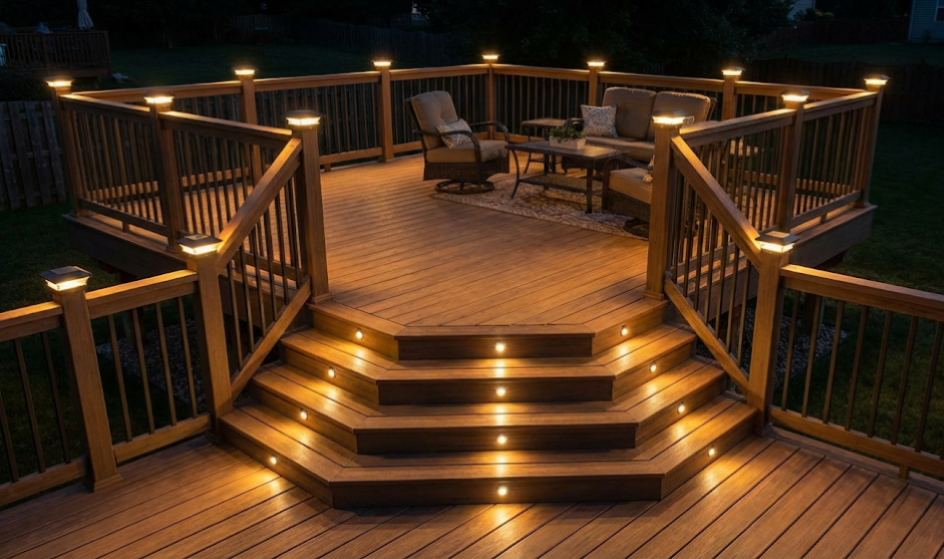
Safety-focused accent lights — especially deck step lighting and deck railing lights — typically land in the 50–200 lumen range per fixture. Their job isn’t to flood an area with light; it’s to clearly define edges, steps, and transitions to prevent trips and falls. These recommendations align with industry lighting standards set by the Illuminating Engineering Society.
| Fixture Type | Recommended Lumens | Best Use | Notes |
|---|---|---|---|
| Deck Step Lighting | 100–200 lumens | Stair edges & risers | Safety-critical; use consistent spacing |
| Deck Railing Lights | 50–150 lumens | Rail illumination & boundary | Avoid upward glare for neighbors |
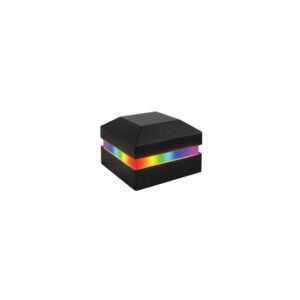
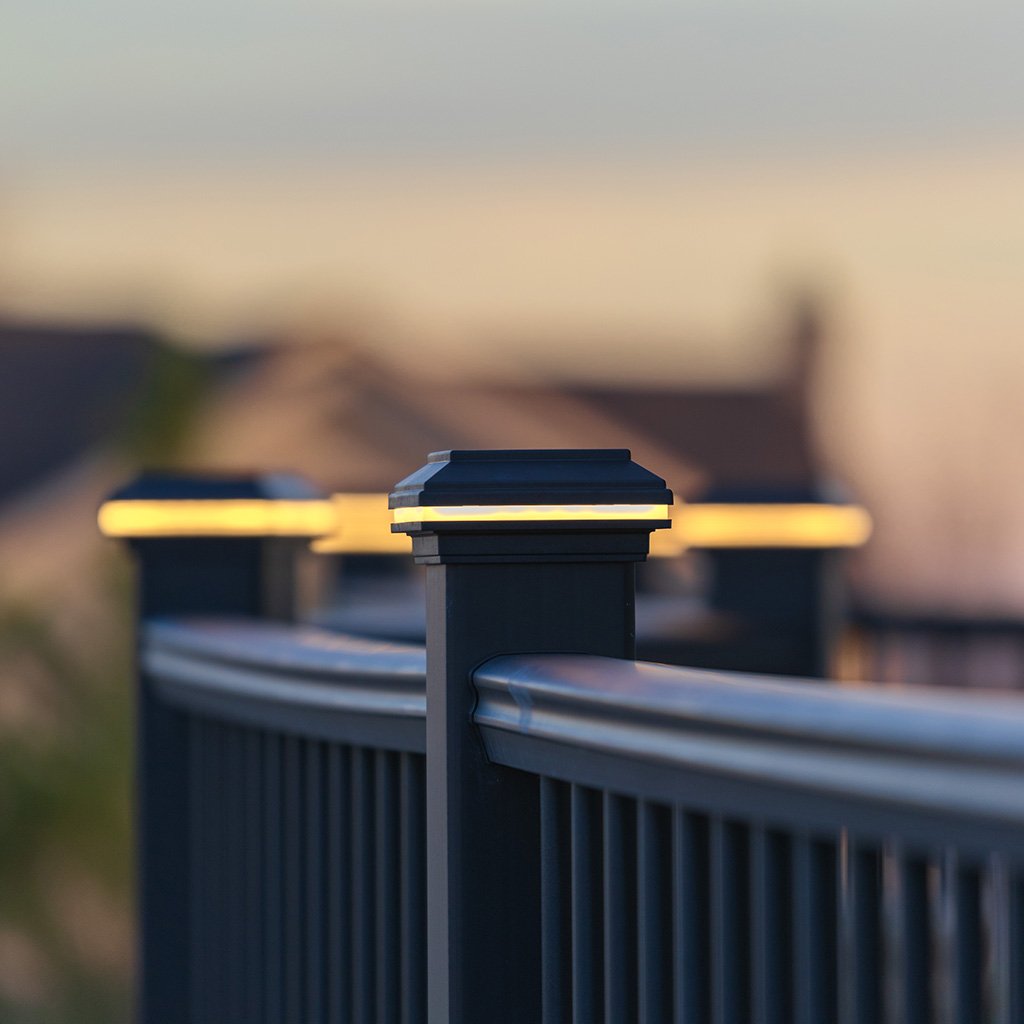
| Post Cap Lights | 100–300 lumens | Ambient perimeter lighting | Choose warm color temperatures (2700–3000K) |
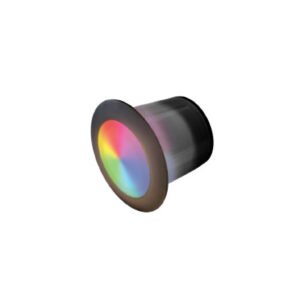
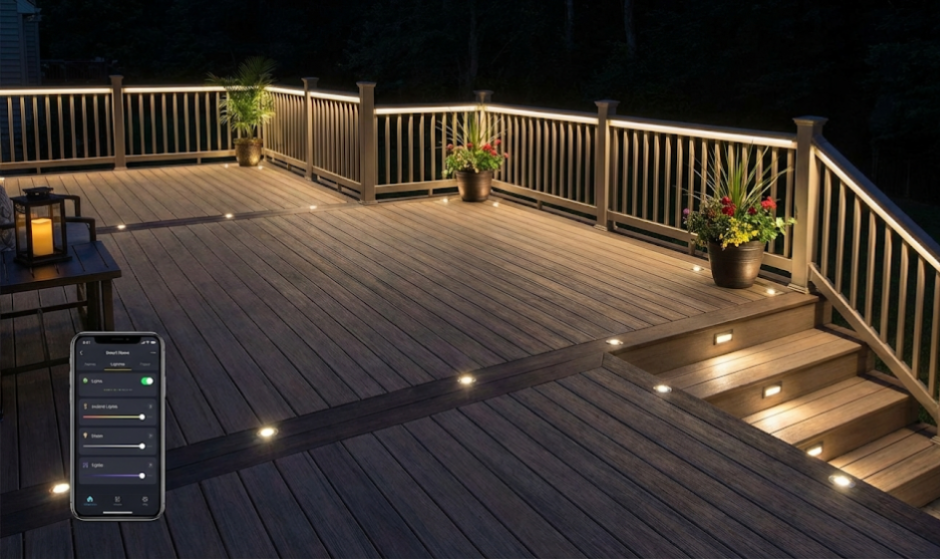
| Recessed Deck Lighting | 150–400 lumens | Task areas & walking surfaces | Flush mount for clean look |
| Under Deck Lighting | 200–600 lumens | Covered patio/ceiling lighting | Higher output needed for larger areas |
| Deck Lighting Kits | Varies (often 50–200/fixture) | Starter setups for whole deck | Check total kit lumen output |
| Waterproof Deck Lights | Depends on type | Any wet/exposed outdoor area | Requires IP65 or higher rating |
The best results come from a layered lighting design: multiple fixture types working together, each calibrated for its purpose.
If you primarily use your deck for evening entertaining — dinner parties, relaxed conversation — choose fixtures in the 100–250 lumen range and layer multiple sources. Overly bright single-source lighting creates harsh shadows and reduces comfort.
If your deck has a covered area or under deck ceiling, choose under deck lighting with outputs between 300 and 600 lumens. Covered areas absorb more light, so higher output is necessary to achieve adequate brightness without harsh contrast with open areas.
If your main concern is safety and navigation — particularly for households with children or elderly family members — prioritize deck step lighting and deck railing lights in the 150–200 lumen range. These zones carry the highest fall risk and should never be under-lit.
If you’re using a deck lighting kit as a starter solution, check the total kit output against your deck’s square footage before buying. Many budget kits underperform in large open deck areas.
Pros:
Cons:
Pros:
Cons:
Adopting responsible outdoor lighting practices helps reduce light pollution and protects local wildlife while maintaining a beautiful outdoor space.
DO:
DON’T:
Consider a homeowner with a 20′ x 20′ deck featuring a seating area, a small grilling station, and a staircase with six steps leading to the yard. Here’s how they might apply these principles:
Total output: Approximately 3,300 lumens distributed across four zones, each calibrated for its purpose. This layered approach avoids both over-lighting and dark spots.
How many lumens do you need for deck step lighting? Each step light should produce 100–200 lumens. Install one fixture per step and aim the light downward across the tread to illuminate the surface without creating glare.
What lumen level is right for deck railing lights? Deck railing lights work best between 50 and 150 lumens. The goal is to define the boundary of your deck and add atmosphere, not to flood the area with brightness.
How bright should post cap lights be? Post cap lights typically range from 100 to 300 lumens. For general ambient use on a mid-size deck, 150–200 lumens per cap is a solid starting point.
Are deck lighting kits bright enough for a large deck? It depends on the kit. Check the total lumen output across all included fixtures. For decks over 300 square feet, budget kits often under-deliver. Look for kits with expandable options or supplement with additional fixtures.
Do I need waterproof deck lights for all fixtures? Any fixture installed in an exposed outdoor area should be rated IP65 or higher. Under-deck or covered porch fixtures may tolerate IP44, but IP65 is the safer standard for all outdoor deck applications.
What color temperature works best for deck lighting? Warm white light (2700–3000K) is the most popular choice for residential decks. It creates a natural, inviting atmosphere. Use slightly cooler tones (3000–3500K) for task areas where visual clarity matters more.
How does recessed deck lighting compare to surface-mounted fixtures? Recessed deck lighting provides a clean, low-profile look ideal for decking boards or stair risers. Surface-mounted fixtures tend to cast light in a wider spread and are easier to install. Both can deliver appropriate lumen levels depending on the model. Unsure which to choose? Compare recessed versus surface-mounted options to see what fits your deck style.
Can I use solar-powered fixtures for deck lighting? Solar deck fixtures work well for accent and ambient applications in areas that receive adequate daily sunlight. They typically produce 10–50 lumens and are not suitable for staircase safety lighting or task zones that require consistent output.
What is under deck lighting and how bright should it be? Under deck lighting refers to fixtures installed on the ceiling of a covered lower level beneath a raised deck. Because covered areas reduce ambient bounce light, these fixtures typically need 300–600 lumens to match the brightness of an open deck area.
How do I know if my deck is over-lit? Common signs include visible glare from fixtures, discomfort when sitting in relaxation zones, and complaints from neighbors about light spilling into adjacent properties. Dimmer controls and proper fixture aim can resolve most over-lighting issues.
Lumen: The unit of measurement for total visible light output from a source. Higher lumen counts mean more light; use this number — not watts — to compare fixture brightness.
IP Rating (Ingress Protection): A two-digit code that indicates how well a fixture resists dust and moisture. IP65 means full dust protection and resistance to water jets — the minimum standard for most outdoor deck applications.
Color Temperature (Kelvin/K): A scale describing the warmth or coolness of a light source. Lower Kelvin values (2700–3000K) produce warm, amber-toned light; higher values (4000K+) produce cooler, bluer tones.
Layered Lighting: A design approach that combines ambient, task, and accent lighting in a single space. On a deck, this means using multiple fixture types at calibrated lumen levels rather than relying on a single overhead source.
Knowing how many lumens you need for deck lighting isn’t guesswork — it’s a straightforward calculation once you know your zones, your fixture types, and your primary goals. Use 100–200 lumens for safety-critical areas like stairs and railings, 150–300 for ambient post caps and perimeter lighting, and 300–600 for task and under-deck areas.
The best results come from a layered approach: multiple fixture types working together, each calibrated for its purpose. Whether you’re choosing a deck lighting kit as a starter package or building a custom layout with recessed deck lighting and waterproof deck lights, the principles remain the same.
Ready to upgrade your deck lighting? Browse our full collection of outdoor deck lighting fixtures, deck railing lights, LED post cap lights, and deck lighting kits — all rated for outdoor use and built to last.
Key Takeaways A deck that goes dark at sunset is only half a deck. Once the light fades, stairs become
KEY TAKEAWAYS A deck can pass every structural check and still fail inspection because of a light. Many Pennsylvania homeowners