- FREE Shipping on all orders! Limited time!
- support@tru-scapes.com

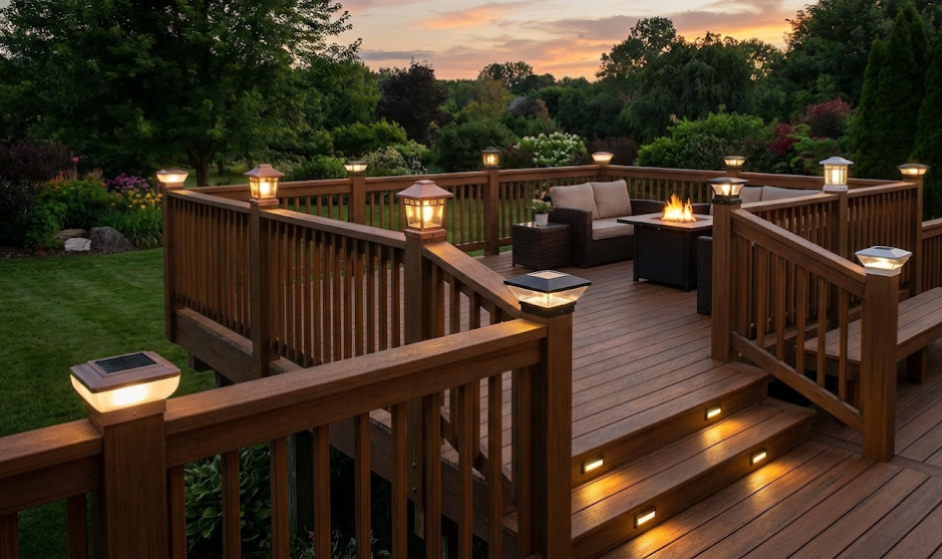
Every year, thousands of Americans are treated for injuries from falls on outdoor stairs and decks. The Consumer Product Safety Commission consistently identifies poor lighting as a contributing factor in nighttime outdoor falls. A solid safety guide for your deck begins at the steps — the transition point where foot placement errors happen most often.
Deck step lighting does more than illuminate a path. Done well, it defines edges, signals elevation changes, and tells the eye exactly where to place the next step. Whether you are entertaining guests after sunset or simply heading out to check the grill, the right outdoor deck lighting system turns a potential hazard into a confident, well-lit passage.
This guide covers everything from choosing the correct fixture type to wiring approaches, placement strategy, and long-term maintenance. By the end, you will have the knowledge to plan a lighting setup that genuinely improves safety — not just aesthetics.
- Deck step lighting is one of the most effective safety upgrades you can make to an outdoor deck.
- This safety guide covers recessed deck lighting, deck railing lights, and post cap options.
- Waterproof deck lights rated IP65 or higher are essential for long-term outdoor durability.
- Solar, low-voltage systems, and line-voltage systems each suit different deck sizes and budgets.
- Poor lighting placement is a leading contributor to nighttime deck falls, according to home safety organizations.
- Regular inspection and bulb replacement keep your deck lighting system performing reliably year-round.
The deck lighting market offers a wide range of fixture types, each suited to specific applications. Before purchasing, it helps to understand the key categories.
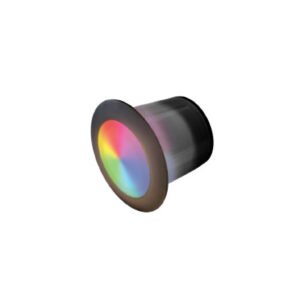
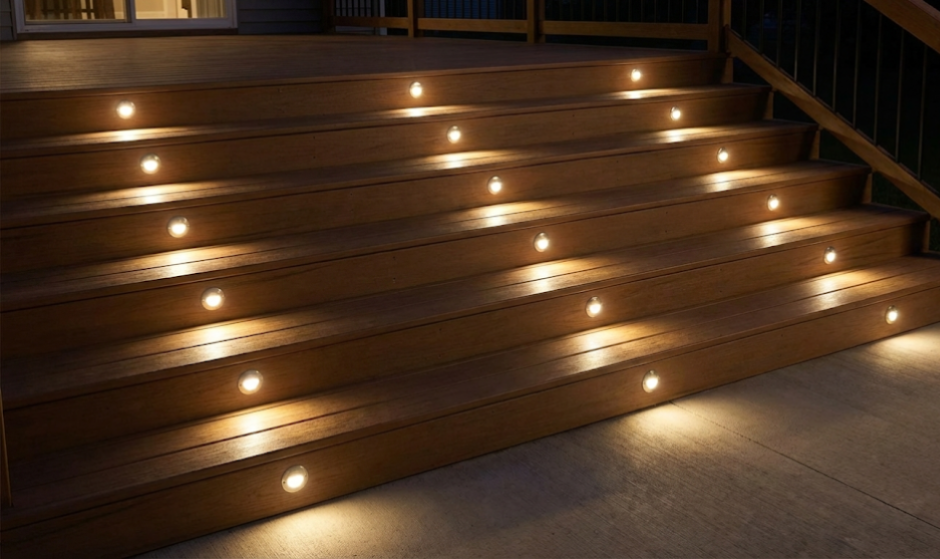
Recessed deck lighting mounts flush into the riser or tread of each step. These fixtures cast light downward and forward, defining the edge of each step without creating glare. They are among the cleanest-looking options and work well in both contemporary and traditional deck designs. Because they sit below the walking surface, they are less prone to physical damage from foot traffic or furniture.
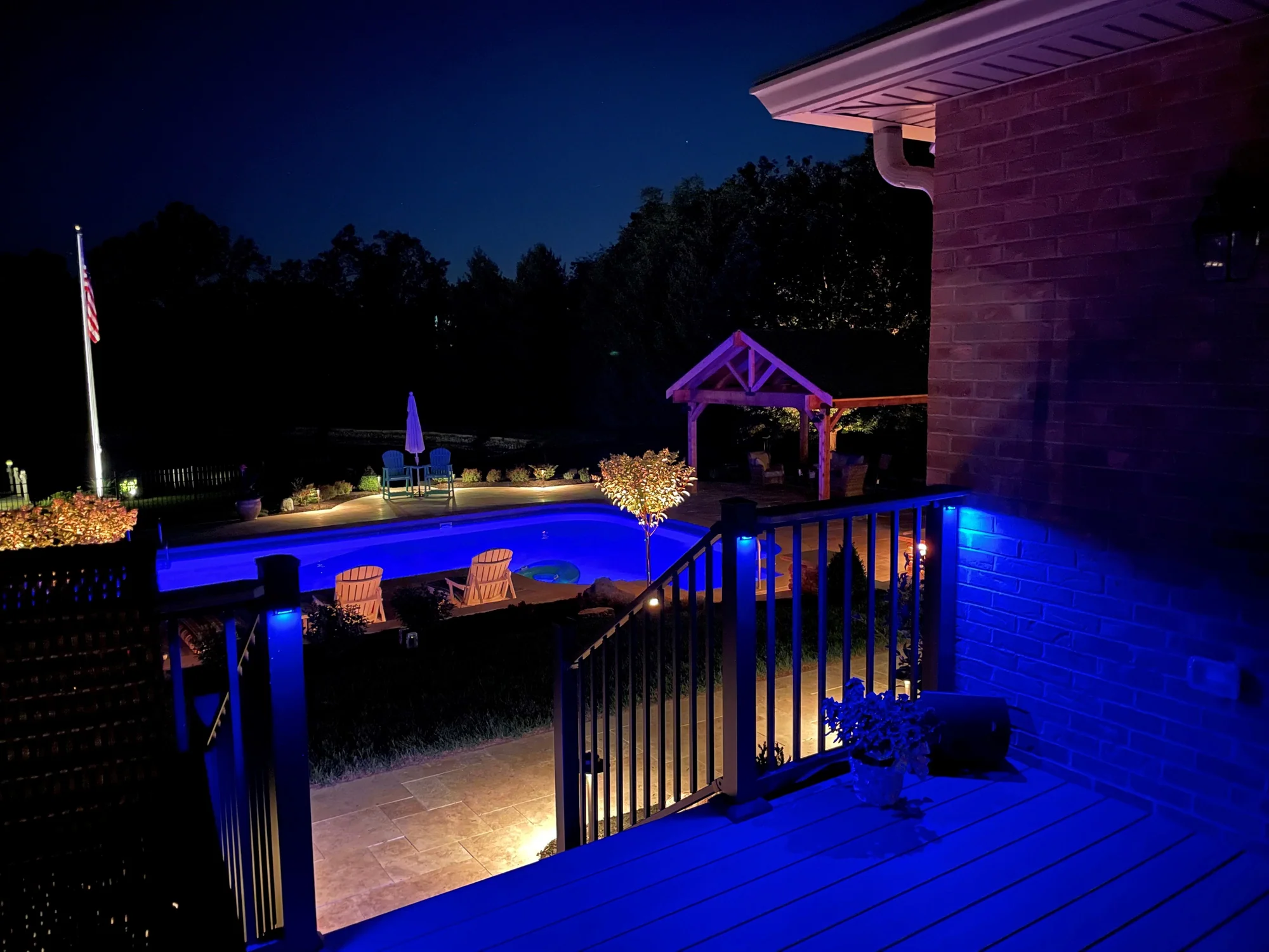
Deck railing lights attach to the vertical posts or horizontal rails along the perimeter of your deck. While they do not illuminate steps as directly as riser-mounted options, they create ambient glow that visually anchors the stair opening and helps guests locate where stairs begin. They pair well with other fixture types as part of a layered lighting plan.
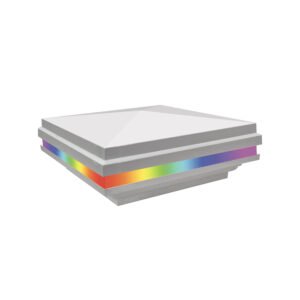
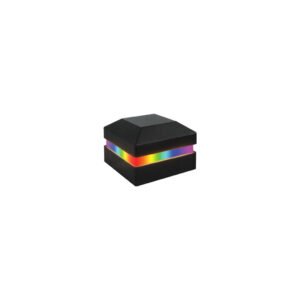
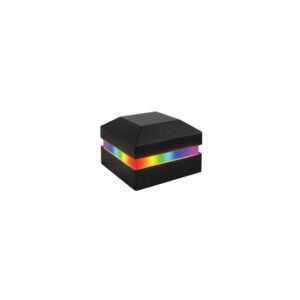
Post cap lights sit atop the structural posts of your deck railing. They provide broad, downward-casting light that improves overall visibility across the deck surface and stairway. Post cap lights work especially well at the top and bottom posts of a stair run, framing the entry and exit points.
Under deck lighting mounts beneath the deck framing and is more commonly used for general illumination of the area below a raised deck. If your stairs pass through this zone, under-deck fixtures can supplement step-level lighting effectively.
For homeowners who prefer a complete solution, deck lighting kits bundle compatible fixtures, transformer, wire, and connectors in a single package. Kits simplify the purchasing process and ensure all components are rated to work together. They are especially convenient for first-time installers.
One of the most consequential decisions in any deck lighting project is the power source. The three main options are solar, low-voltage (12V), and line-voltage (120V) systems.
| Feature | Solar | Low-Voltage (12V) | Line-Voltage (120V) |
|---|---|---|---|
| Installation difficulty | Easy | Moderate | Requires licensed electrician |
| Operating cost | Free (after install) | Low | Higher |
| Brightness | Low to moderate | Moderate to high | High |
| Reliability | Weather-dependent | Consistent | Consistent |
| Ideal for | Small decks, limited runs | Most residential decks | Large decks, high output |
| Waterproof requirement | Yes | Yes | Yes |
If you need bright, consistent illumination across a multi-level deck with a long stair run, choose low-voltage systems or line-voltage systems. If your deck is small and your stair run is short with good sun exposure, solar deck lighting can be a cost-effective starting point.
Low-voltage systems are the most popular choice for DIY installation. Here is a straightforward approach for a standard deck stair run.
Step 1: Plan fixture placement. Measure the height and depth of each step riser. Decide whether you want lights on every step, every other step, or only at key intervals. For safety, every step on a run longer than four stairs should be lit.
Step 2: Select a compatible transformer. Your transformer must handle the total wattage of all fixtures plus a 20% buffer. Most residential low-voltage transformers run between 150W and 600W. Look for models with a built-in timer or photocell sensor. To ensure you select a compatible transformer that handles the load correctly, consult detailed sizing guides before purchasing.
Step 3: Run landscape wire. Use 12- or 14-gauge direct-burial landscape wire. Route wire along the inside of the stair stringer or beneath the deck framing, keeping it away from foot traffic areas. Learning how to properly run landscape wire ensures a clean installation and prevents future connection issues.
Step 4: Mount the fixtures. Drill appropriately sized holes in each riser according to the fixture manufacturer’s specifications. Insert the fixture housing and secure it. For recessed deck lighting, confirm the lens sits flush with or slightly below the riser surface.
Step 5: Connect the wire. Use weatherproof connectors provided with the kit or sold separately. Most snap-style connectors pierce the wire insulation; no stripping is required. Ensure each connection is tight and protected from moisture intrusion.
Step 6: Mount and program the transformer. Install the transformer on an exterior wall or post near a GFCI-protected outlet. Set the on/off timer or connect the photocell lead. Test the full circuit before securing all wire runs.
Step 7: Test and adjust. Walk the stair run after dark. Check for hot spots, shadows, or fixtures aimed in the wrong direction. Adjust the angle of adjustable-head fixtures as needed.
Fixture selection accounts for half the equation; placement accounts for the other half. Even high-quality waterproof deck lights underperform when positioned incorrectly.
The goal of step lighting is edge definition. Light should reveal where the tread ends and the riser begins. A fixture mounted too high on a riser creates a bright spot but leaves the tread edge in shadow. Mounting the fixture in the lower third of the riser — typically 2 to 4 inches from the tread surface — produces the most useful result.
Avoid aiming fixtures directly at eye level for anyone walking down the stairs. Glare in descending users’ eyes reduces visual acuity and creates a safety risk instead of reducing one. Indirect or shielded optics manage this problem better than bare-bulb fixtures.
For deck railing lights used at stair openings, place a fixture on each gatepost or newel post flanking the stairs. This frames the entry visually and draws attention to the transition before someone reaches the first step.
Pros:
Cons:
Do:
Don’t:
Consider a homeowner in Minnesota with a two-level deck and a 10-step stair run. The deck faces west and receives good afternoon sun but is shaded in the morning. After two seasons with solar post cap lights that failed to charge reliably in November, the homeowner switched to a 300W low-voltage transformer with recessed riser fixtures on every step and post cap lights at the top and bottom newel posts. The result was consistent illumination from dusk to dawn regardless of season or cloud cover — and no further incidents during the family’s winter gatherings.
This scenario illustrates a principle endorsed by the National Safety Council and echoed by home safety professionals: reliability matters more than initial cost when safety is at stake.
Q: How many lumens do deck step lights need? A: For step lighting, 10–50 lumens per fixture is typically sufficient. The goal is edge definition, not flood illumination. Too much brightness creates glare that actually reduces visibility.
Q: Are deck step lights waterproof? A: Quality outdoor deck lighting fixtures carry an IP (Ingress Protection) rating. Look for IP65 or higher for exposed locations. IP65 means the fixture is dust-tight and protected against water jets from any direction.
Q: Can I install deck step lights myself? A: Solar and low-voltage systems are DIY-friendly for most homeowners. Line-voltage (120V) systems should be installed by a licensed electrician in most states to comply with the National Electrical Code (NEC).
Q: How far apart should deck step lights be placed? A: On a standard stair run, one fixture per step is the gold standard for safety. If budget is a constraint, place fixtures on every other step with supplemental railing or post lighting to fill gaps.
Q: What is the best color temperature for deck step lighting? A: Warm white (2700K–3000K) is the most popular choice for residential decks. It is visually comfortable and does not wash out the deck’s natural wood tones.
Q: Do deck step lights need their own circuit? A: Low-voltage systems run from a single transformer plugged into a GFCI outlet — no dedicated circuit required. Line-voltage systems may require a dedicated circuit depending on total load; consult a licensed electrician.
Q: How long do LED deck step lights last? A: Quality LED fixtures typically carry rated lifespans of 25,000–50,000 hours, as noted by the U.S. Department of Energy’s LED lighting resources. In a typical evening-use scenario, that translates to 15–20 years of service before replacement.
Q: Can deck step lights be used in freezing temperatures? A: Yes, provided they carry a temperature rating appropriate for your climate. Most quality waterproof deck lights are rated for use in temperatures as low as -40°F / -40°C.
Q: What is the difference between deck lighting kits and individual fixtures? A: Kits include matched components — transformer, wire, connectors, and fixtures — ensuring compatibility and simplifying installation. Individual fixtures allow more customization but require separate selection of each component.
Q: Do deck step lights deter intruders? A: Lighting is a recognized passive deterrent. Well-lit entryways and stairs reduce concealment opportunities. This is a secondary benefit of a system installed primarily for safety.
IP Rating (Ingress Protection): A two-digit code defined by IEC standard 60529 that describes how well a fixture resists solid particles and liquids. For outdoor deck lights, IP65 or higher is recommended. Learn more about waterproof deck lights and their ratings.
Low-Voltage Lighting: An electrical lighting system operating at 12 volts DC, powered by a transformer that steps down standard household current. Low-voltage systems are safer to install and maintain than line-voltage systems.
GFCI (Ground Fault Circuit Interrupter): A safety device that monitors electrical current and shuts off power within milliseconds if it detects a ground fault. Required by the NEC for all outdoor electrical outlets and circuits.
Lumen: The unit of measurement for visible light output. Higher lumens means more light. In step lighting, lower lumen values (10–50 per fixture) are preferred to provide edge definition without glare.
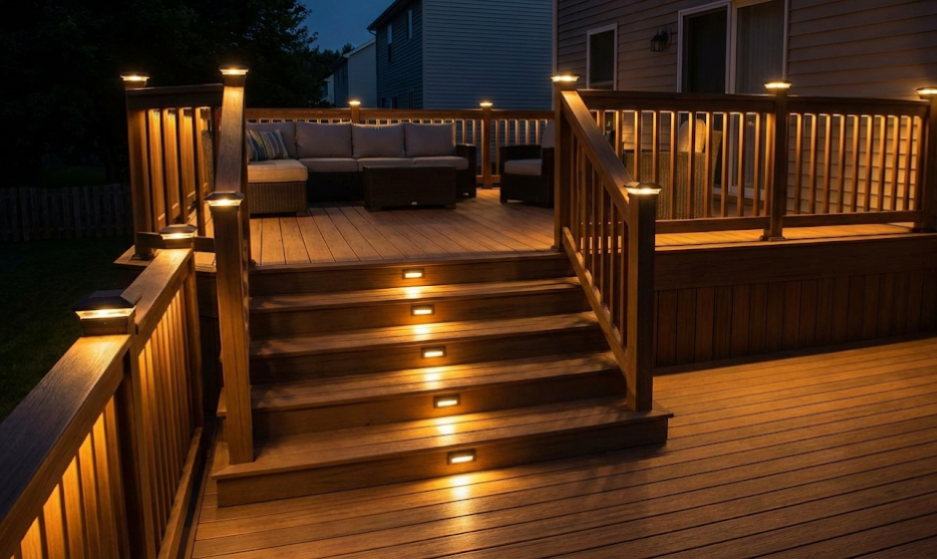
A complete outdoor deck lighting plan does not need to be complicated or expensive. The fundamentals are straightforward: choose weather-rated fixtures, size your transformer correctly, mount lights in the lower riser third for edge definition, and test your system before relying on it after dark.
This safety guide has walked through every major decision — fixture types, power sources, installation steps, placement strategy, and maintenance — so you have a complete framework to work from. The right deck railing lights, recessed deck lighting, or post cap fixtures make your outdoor space usable and safe year-round, not just during daylight hours.
Start with your stair run, address every step, and layer in ambient lighting from railing and post cap fixtures. Your deck, your guests, and your peace of mind will all be better for it.
Ready to upgrade your deck? Browse our selection of waterproof deck lights and deck lighting kits to find the right system for your space.
Color-changing outdoor lights have a reputation problem. Done poorly, they turn a beautiful backyard into something that looks like a
Outdoor spaces have quietly become the heart of the American home, and color-changing deck lights are leading the shift from